


 About Urh Social
 Terms of Service
 Privacy Policy
 Contact
From Physical to Digital: How 3D Laser Scanning Is Revolutionizing Manufacturing
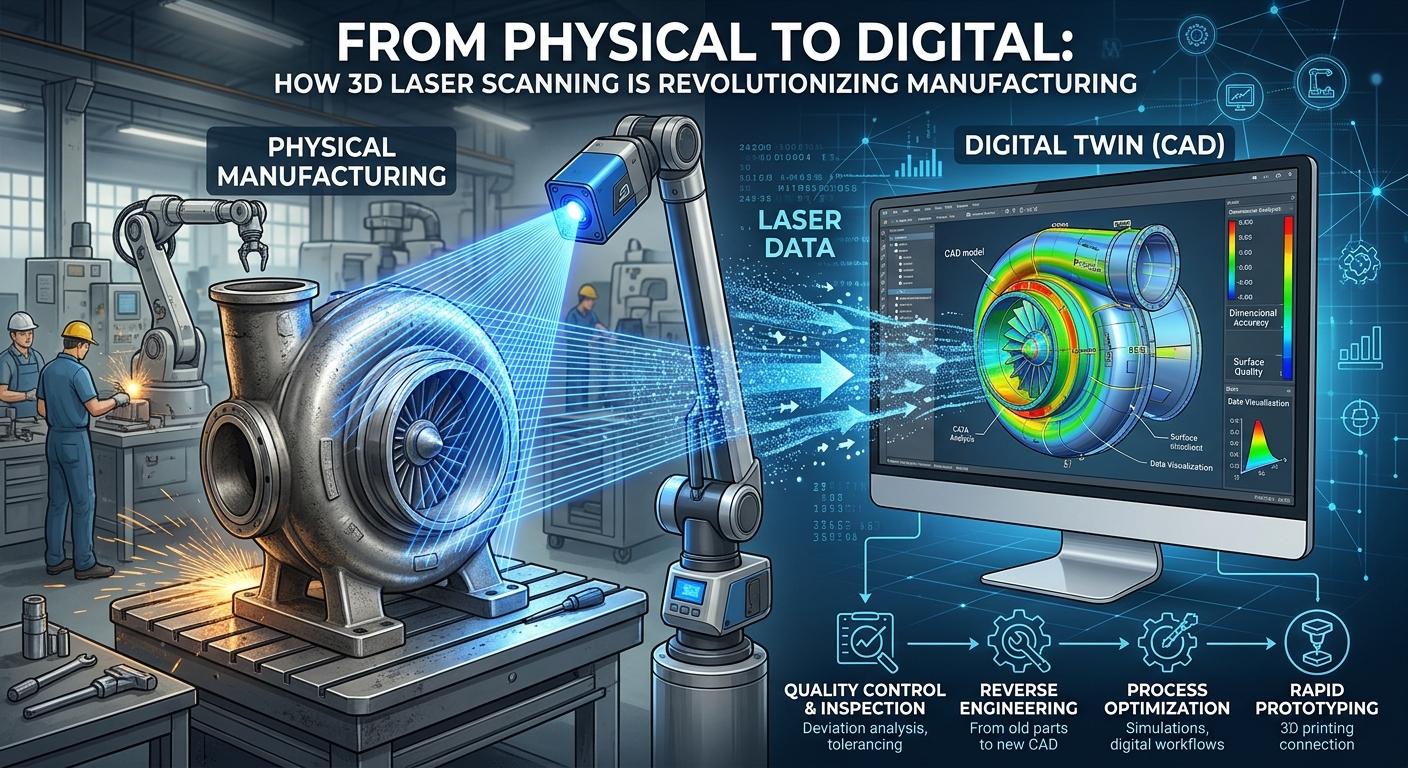
In industries ranging from automotive engineering to product design, capturing the physical world with extreme accuracy is no longer a luxury—it is a necessity. Traditional measurement tools like calipers and tape measures often fail when applied to complex curves, intricate geometries, or delicate materials. This is where a 3D laser scanner steps in, bridging the gap between physical objects and digital environments.
By capturing millions of data points in seconds, a 3D laser scanner allows engineers, creators, and manufacturers to create highly detailed 3D models for reverse engineering, quality inspection, and 3D printing. Understanding how this technology works, where it provides the most value, and how to select the right device can streamline your production workflow and cut design cycles significantly.
What Is a 3D Laser Scanner and How Does It Work?
A 3D laser scanner is a non-contact, non-destructive device that uses laser light to capture the exact shape, contours, and physical measurements of an object. The process generates a dense collection of coordinate points known as a "point cloud." This point cloud is then converted into a polygonal mesh or 3D CAD model for further editing, analysis, or replication.
The Science Behind Laser Scanning
Laser-based 3D scanning relies primarily on two main principles:
-
Triangulation: The scanner projects a laser line or dot onto the target object. A camera positioned at a known distance from the laser source captures the reflected light. By measuring the angle of the reflection, the software calculates the exact position of that point in 3D space.
-
Time-of-Flight: Used mostly for long-range spatial or architectural scanning, this method measures the exact time it takes for a laser pulse to travel to an object and bounce back.
Because laser scanning relies on emitted light rather than ambient light, it can operate effectively in varying lighting conditions and capture hard-to-reach features with high repeatable accuracy.
Key Applications Across Modern Industries
The versatility of the 3D laser scanner makes it an essential tool across multiple disciplines.
1. Reverse Engineering
When original CAD drawings are outdated, incomplete, or missing entirely, a 3D laser scanner enables engineers to digitize existing parts. Once scanned, the physical object's geometry can be imported into CAD software to recreate design blueprints, make modifications, or produce replacement components for legacy systems.
2. Quality Control and Industrial Inspection
Ensuring that manufactured parts meet precise tolerances is critical in high-stakes fields like aerospace and automotive manufacturing. Scanning a finished component produces a detailed 3D map that can be overlaid against the original CAD file. This highlights deviations, warping, or manufacturing defects before parts reach assembly lines.
3. Rapid Prototyping and 3D Printing
For digital artists, makers, and product designers, turning a physical prototype into a digital asset is the fastest route to production. A high-resolution scan provides clean mesh files ready for modification and high-definition 3D printing.
Selecting the Right 3D Scanning Solution
Choosing the right device depends on several factors, including object size, required accuracy, mobility needs, and budget. While heavy industrial systems were once the only option for precise digitization, advances in hardware design have brought professional-grade precision into accessible, compact formats.
Brands like Revopoint 3D are leading this shift by developing high-precision 3D scanning technology designed to meet rigorous standards without the massive footprint or complexity of traditional systems. By making advanced optical systems and intelligent software available to creators, engineers, and businesses worldwide, Revopoint 3D helps bridge the gap between high performance and practical everyday application.
When evaluating a 3D laser scanner for your workspace, focus on three primary specifications:
-
Accuracy and Resolution: Accuracy defines how close the scanned dimensions are to the actual object, while resolution determines the level of fine detail captured.
-
Working Volume and Range: Consider whether you need to scan tiny mechanical components, handheld tools, or large industrial vehicles.
-
Portability and Software: Lightweight handheld designs paired with intuitive processing software significantly lower the learning curve and improve field utility.
Best Practices for Achieving High-Quality Scans
To maximize the performance of a 3D laser scanner, proper technique and surface preparation are essential.
-
Prepare Difficult Surfaces: Transparent, extremely shiny, or pitch-black surfaces can disrupt laser reflections. Applying a temporary matte scanning spray neutralizes glare and ensures clean data capture.
-
Maintain Proper Tracking: Move the scanner at a steady speed, keeping it within the recommended depth-of-field indicator on your scanning software.
-
Utilize Target Markers: For large objects or featureless surfaces, placing sticky alignment targets helps the software track position continuously without losing orientation.
Conclusion
A 3D laser scanner is a transformative asset that accelerates product development, refines quality control, and simplifies complex design challenges. By turning physical objects into precise digital models in minutes, businesses can eliminate manual measurement errors and bring products to market faster. As technology continues to evolve, high-precision scanning will remain an indispensable driver of innovation across engineering, manufacturing, and creative industries.
Frequently Asked Questions (FAQs)
What is the main difference between a optical structured light scanner and a 3D laser scanner?
While both technologies create 3D models, a structured light scanner projects light patterns onto an object, making it sensitive to ambient lighting. A 3D laser scanner projects focused laser lines, offering better stability when scanning in challenging light conditions or working with dark, reflective materials.
Can a 3D laser scanner capture dark or reflective surfaces?
Yes. Laser scanning technology is generally better suited for dark or shiny surfaces than structured light systems. However, applying a light coat of removable 3D scanning spray is still recommended for mirror-like or fully transparent objects to ensure maximum surface accuracy.
Is a 3D laser scanner hard to operate for beginners?
Modern 3D laser scanning hardware and software are designed with user experience in mind. Auto-alignment features, intuitive user interfaces, and automated mesh cleanup tools make it easy for beginners to achieve professional results with minimal training.
How accurate are handheld 3D laser scanners?
High-precision handheld 3D laser scanners can achieve single-frame accuracy levels down to 0.02 mm to 0.05 mm, making them suitable for industrial reverse engineering and strict quality inspection tasks.

 Arabic
 French
 Spanish
 Portuguese
 Deutsch
 Turkish
 Dutch
 Italiano
 Russian
 Romaian
 Portuguese (Brazil)
 Greek
