


 About Urh Social
 Terms of Service
 Privacy Policy
 Contact
ENT Instruments: Matching Tool Selection to Procedure Needs
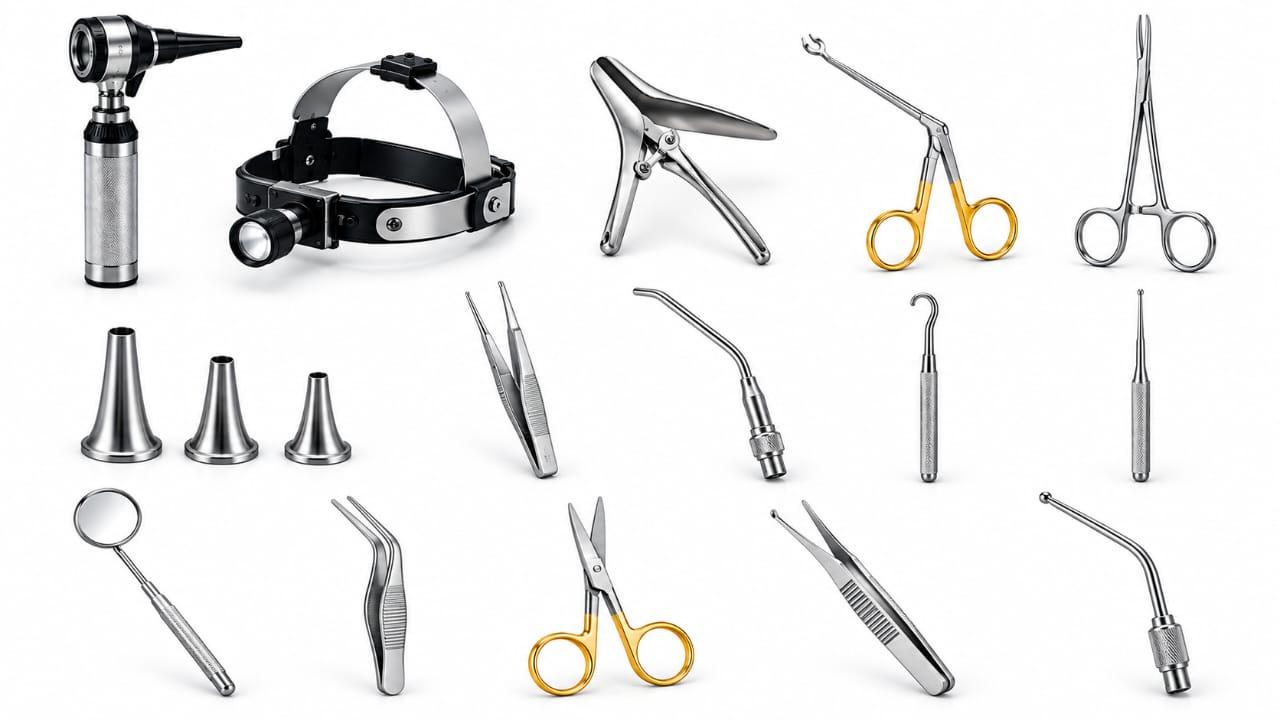
A hospital buyer sends one line: "50 sets of ENT instruments." Which procedures? Without that answer, two suppliers quote the same sets for different jobs, and the theatre receives trays that fit neither.
Start with the procedure, not the catalogue.
This guide shows buyers sourcing for resale, hospitals or their own brand how to map tools to the operating list, then test any maker against it.
Start With the Procedure: How ENT Instruments Map to the OT List
Every procedure draws on a short core of ENT instruments, plus a few specialist pieces. Build it around a price list and the returns begin.
Tonsillectomy: Gag and Grip
The Boyle-Davis gag holds the field open, and tonsil-holding forceps control the tissue.
Septoplasty: Elevators Decide the Flap
Freer and Cottle elevators lift the mucoperichondrial flap, so edge finish matters more than weight. A nicked edge tears tissue.
Sinus Work: Reach and Cleaning Access
Blakesley forceps and fine suction tubes reach deep, and both hide residue in narrow channels. Most buyers compare length and skip a harder question: does the finished set fit the hospital's sterilisation container? Nobody tells you until the tray won't close.
Five Questions That Show a Maker Understands Procedures
A catalogue lists ENT equipments. Only a specialist maps them to surgery. Put these five questions to every candidate.
-
Procedure mapping. Ask them to list a septoplasty set without opening a catalogue. Bad answer: "Tell us what you need."
-
Tray fit. Ask whether sets fit standard sterilisation containers. Bad answer: "They'll fit."
-
Autoclave testing. ISO 13402 covers resistance to autoclaving, corrosion and thermal exposure, so ask whether samples were tested against it. Bad answer: "Stainless steel handles anything."
-
Set consistency. Ask how identical sets are controlled across batches. Bad answer: "We match them by eye."
-
Mismatch terms. Ask for written terms on wrong or incomplete sets. Bad answer: "We'll replace what we can."
What Procedure-Matched Sets Do for Your Margin
Selling one generic set to every theatre is the fastest route to returns. Procedure-matched ENT instruments protect margin in six ways:
-
Fewer wrong-set returns: the set matches the list, so nothing travels back.
-
Faster surgeon sign-off: clinicians approve sets that mirror their own procedure lists.
-
Cleaner stock: each SKU maps to a procedure, so slow lines show up early.
-
Predictable reorders: identical sets keep trays interchangeable across months.
-
Brand protection: an incomplete set reflects on the label printed on the box.
-
Regulatory cover: surgical instruments fall under CDSCO's 2017 device rules, so procedure-wise records support inspections.
Why Jalandhar Makes Custom Set Orders Easier
Jalandhar is known for sports goods and surgical instruments, so forging, heat-treatment and plating vendors sit within the same cluster. Which means a custom pattern changes hands fewer times before packing. Numerous ENT instruments manufacturers in India cluster in this belt. Our buyers include ENT instruments dealers in India, private-label brands and ENT instruments wholesalers in India placing hospital set orders, and some ENT instruments suppliers in India also route set orders to us. Our workshop is at 1382/1046, Raja Garden, Basti Danishmandan, near Vishal Tools, Jalandhar – 144002, Punjab.
Why 59 Years of Set Orders Made Us Keep a Master Pattern
Our workshop opened in 1967, and ISO certification covers our work. One habit has paid off: we keep a master set of each pattern on file and compare every reorder against it before packing.
That comparison catches drift early.
Send Your Procedure List and Quantities, and We Quote Within One Working Day
Tell us which procedures you supply, the instruments per set, the metal grade, finish, order quantity and delivery country. Add the tray size if you know it. Expect a quote and sample schedule inside one working day. Our smallest run: 100 pieces for each design. Share your procedure list with Surgifact and we'll build the set plan with you.
Where Procedure-Based Buying Is Heading
Hospitals now want sets built around their lists, not loose catalogue pieces. Which means the ENT instruments manufacturers that document every set pattern will win the repeat tenders. Choose the ones already doing it.
Questions Buyers Ask Us About ENT Sets
Which ENT instruments belong in a basic septoplasty set?
A nasal speculum, Freer and Cottle elevators, a swivel knife and suction tubes form the usual core. Surgeons vary, so confirm the list with your end user.
How do ENT instruments suppliers build sets for a new hospital?
They start from the hospital's procedure list, then group instruments into trays that fit its sterilisation containers. A good supplier asks for tray size before quoting.
Can ENT instruments wholesalers supply procedure-wise sets?
Many stock loose patterns only. Matched sets need the maker's drawings, so ask whether the wholesaler can provide the set list and lot data together.
Do ENT instruments dealers accept returns on wrong sets?
Terms vary by dealer. A dealer's return rights depend on the maker's, so get the conditions in writing before you buy.
How many sets should a first order include?
Cover your busiest day plus one spare set, then reorder against real turnover. One caveat: I can't give a firm number without seeing the hospital's list.
What does ISO 13402 prove about hand instruments?
It defines how to test resistance to autoclaving, corrosion and thermal exposure. It is a test method, not a guarantee, so run your own cycles on samples too.
What is the smallest trial order for ENT instruments wholesalers in India?
Sets begin at 100 pieces for each design, and a mixed procedure trial can sometimes be arranged. Share the list first and we'll confirm.

 Arabic
 French
 Spanish
 Portuguese
 Deutsch
 Turkish
 Dutch
 Italiano
 Russian
 Romaian
 Portuguese (Brazil)
 Greek
