


 About Urh Social
 Terms of Service
 Privacy Policy
 Contact
Can Toy Rotation Make Play More Fun?
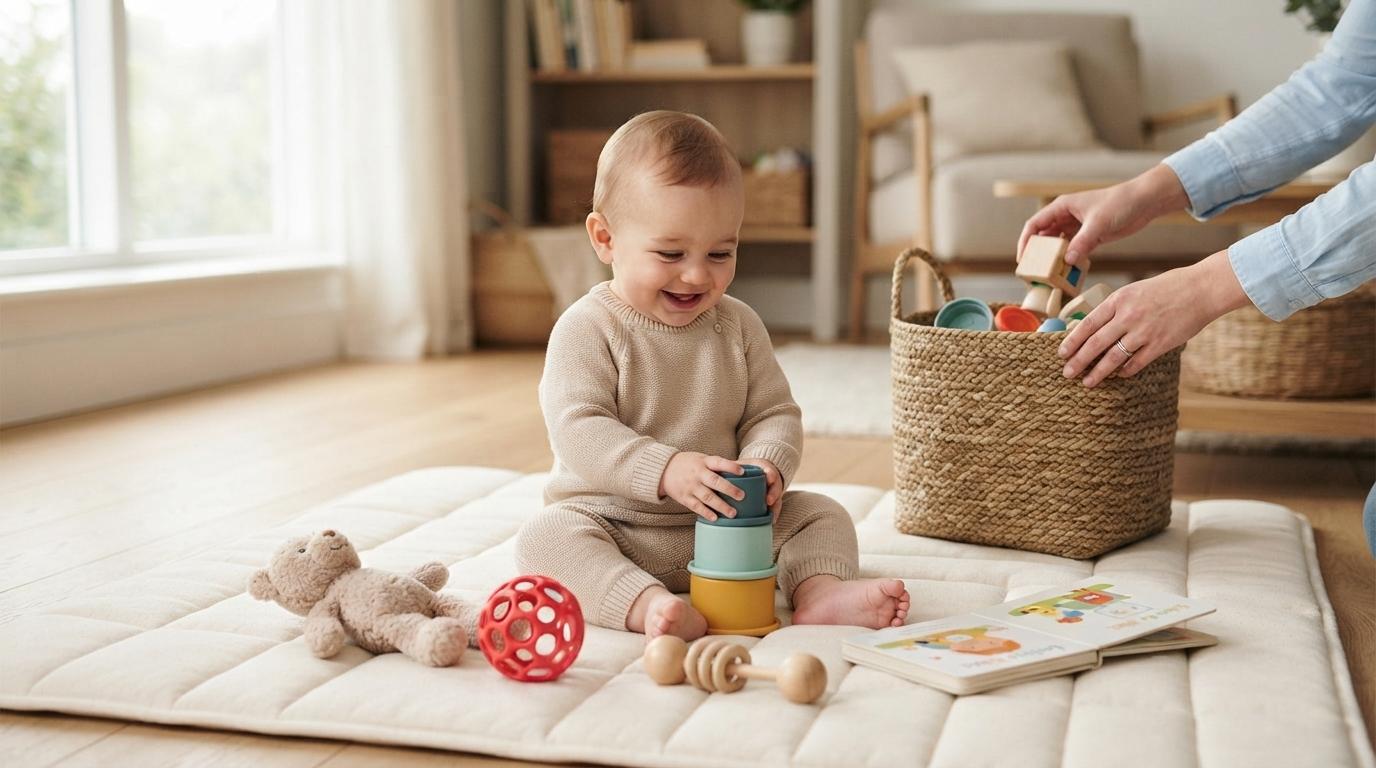
Learn how rotating your baby’s toys can make play more interesting, reduce clutter, and help your little one explore, focus, and learn.
Can Toy Rotation Make Play More Fun?
Baby shop choices can sometimes make parents wonder how many toys their little one really needs. Babies do not always need a large collection to enjoy play. In fact, having fewer toys available at one time can make play more interesting. This simple idea is called toy rotation, and it can help babies notice, explore, and enjoy their toys in new ways.
What Is Toy Rotation?
Toy rotation means keeping a small number of toys available while putting some others away for a while. After a few days or weeks, you can replace some of the available toys with the ones you stored.
For example, you might keep five or six toys in your baby's play area. Later, you can replace two or three with different toys.
The goal is not to take away your baby's favorite toys. It is simply a way to offer some variety without putting everything out at once.
Why Can Rotating Toys Help?
It Can Make Old Toys Feel New
Babies are naturally curious, but they can lose interest when they see the same toys every day. When you put a familiar toy away for some time and bring it back later, your baby may become interested in it again. They may touch it, turn it around, shake it, or try to discover what it does. You may be surprised by how exciting an old toy can seem after a short break.
Fewer Choices Can Help Babies Focus
A play area filled with toys can sometimes become distracting. Your baby may quickly move from one toy to another without spending much time exploring. With toy rotation, you can offer a smaller selection. This can give your baby more time to focus on each toy.
For example, you could offer a soft toy, stacking cups, a ball, and a simple activity toy instead of putting ten toys on the floor.
A simple play space can give your baby more freedom to explore without too many distractions.
Can Toy Rotation Support Learning?
Toy rotation can create more opportunities for learning through play. Different toys encourage different types of movement, thinking, and exploration. A stacking toy can encourage your baby to pick up and place objects. A ball can encourage reaching, crawling, rolling, or throwing. A musical toy can help your baby notice sounds and understand that their actions can create a response.
It Encourages Curiosity
Babies learn by trying things. They touch, shake, pull, push, drop, and turn objects to see what happens. Rotating toys gives them different things to investigate over time. You do not need expensive or complicated toys. Simple toys can provide many opportunities for discovery.
It Can Encourage Independent Play
When your baby has a few suitable toys nearby, they can choose what they want to explore. You can stay nearby and watch without showing them exactly how to use every toy. Letting your baby experiment gives them space to discover things on their own. Sometimes babies use toys in ways adults do not expect, and that is part of learning.
How Often Should You Rotate Toys?
There is no perfect schedule. Some parents rotate toys every few days, while others do it once a week or every two weeks. Choose whatever works for your family. Pay attention to your baby's behavior. If your baby is still enjoying the toys available, there is no need to change them. If they seem bored or start looking for something different, you can introduce a few toys from storage. Toy rotation should make play easier, not become another stressful job for parents.
How Many Toys Should You Keep Out?
There is no magic number. You can start with four to six toys and see what works for your baby.
Try choosing toys that offer different types of play. For example:
- One stacking or building toy
- One soft or sensory toy
- One ball
- One movement-based toy
- One simple book
- One favorite toy
You can change some of these when your baby starts losing interest.
How to Make Toy Rotation Easy
Use a Simple Storage Box
Put toys that are not currently being used in a clean storage box or basket. Keep the storage area somewhere safe and out of your baby's reach. When it is time to rotate, simply put away a few toys and bring out a few different ones.
Group Similar Toys Together
You can also organize toys by type. Keep books together, building toys together, and sensory toys together. This makes it easier to choose different types of play whenever you rotate the toys.
Keep Favorite Toys Available
Your baby's favorite toy does not always need to be part of the rotation. If your baby enjoys it every day, you can leave it available. The purpose of toy rotation is to create variety, not remove everything your baby loves.
Does Toy Rotation Mean Buying More Toys?
No. One of the best things about toy rotation is that it can work with toys you already own. An older toy may become interesting again simply because your baby has not seen it for a while. This can help you avoid buying something new every time your baby seems bored.
If you want to add new toys, choose age-appropriate options that offer different ways to play. Parents can also browse an online baby store uae selection from home and choose toys based on their child's age and interests.
What About Toys Your Baby Has Outgrown?
As babies grow, their interests and abilities change. A toy that was exciting a few months ago may eventually become too simple. When rotating toys, check that each one is still suitable for your baby's age and development. Always follow the manufacturer's age recommendations and safety instructions.
Check toys regularly for broken pieces, loose parts, sharp edges, or damage. Avoid toys with small parts that could be a choking risk.
Can Parents Join the Play?
Yes. Toy rotation does not replace parent-child interaction. You can sit nearby, talk about what your baby is doing, copy their sounds, sing, or simply watch them explore. If your baby is playing with a ball, for example, you can gently roll it toward them and say, “The ball is coming!”
These small moments can make play more enjoyable while helping you connect with your baby.
A Simple Toy Rotation Example
Imagine your baby has twelve toys. Instead of putting all twelve on the floor, choose five for the current play area. You might select a ball, stacking cups, a soft toy, a board book, and an activity toy. Keep the remaining toys safely stored. The following week, you could replace two or three with a shape sorter, another book, or a sensory toy.
You can continue this simple pattern based on your baby's interests.
For parents looking for different types of baby and children's toys online, toysuae is one option where products can be browsed from home and selected according to a child's needs.
Less Can Sometimes Be More
Toy rotation is not a strict parenting rule. It is simply an easy way to add variety to your baby's playtime. You do not need dozens of toys or a complicated schedule. A few safe and suitable toys can be enough.
By changing some toys from time to time, you may help your baby become interested in toys they had forgotten about and give them new opportunities to explore.
Most importantly, follow your baby's interests. If your little one is happily playing with a simple toy, there is no need to interrupt them just because it is time for a rotation. The best play environment is one where your baby feels safe, curious, and free to explore.
FAQs
1. Does toy rotation really work for babies?
It can help some babies become interested in toys again after they have been stored away for a while.
2. How often should I rotate my baby's toys?
There is no fixed schedule. You can rotate them every few days, weekly, or every couple of weeks depending on your baby's interest.
3. How many toys should I leave out?
You can start with around four to six suitable toys and adjust the number according to your baby's needs.
4. Should I rotate my baby's favorite toy?
Not necessarily. Favorite toys can stay available if your baby enjoys playing with them.
5. Can toy rotation save money?
It can. Bringing back older toys may keep your baby interested without needing to buy new toys frequently.
6. Can toy rotation support learning?
Yes. Different toys can give babies opportunities to practice movement, problem-solving, sensory exploration, and independent play.
7. Are simple toys useful for babies?
Yes. Simple toys can encourage babies to touch, hold, move, stack, shake, roll, and explore.
8. What should I check before giving my baby a toy?
Check the recommended age and make sure the toy has no broken, loose, sharp, or small parts that could create a choking risk.

 English
 Arabic
 French
 Spanish
 Portuguese
 Deutsch
 Turkish
 Dutch
Dutch
 Russian
 Romaian
 Portuguese (Brazil)
 Greek
Greek
