


 About Urh Social
 Terms of Service
 Политика конфиденциальности
 Contact
Anti-Jamming MILSATCOM Systems Market Heads Toward USD 27.0 Bn by 2036: USA Grows at 12.8% CAGR as Protected Links Expand
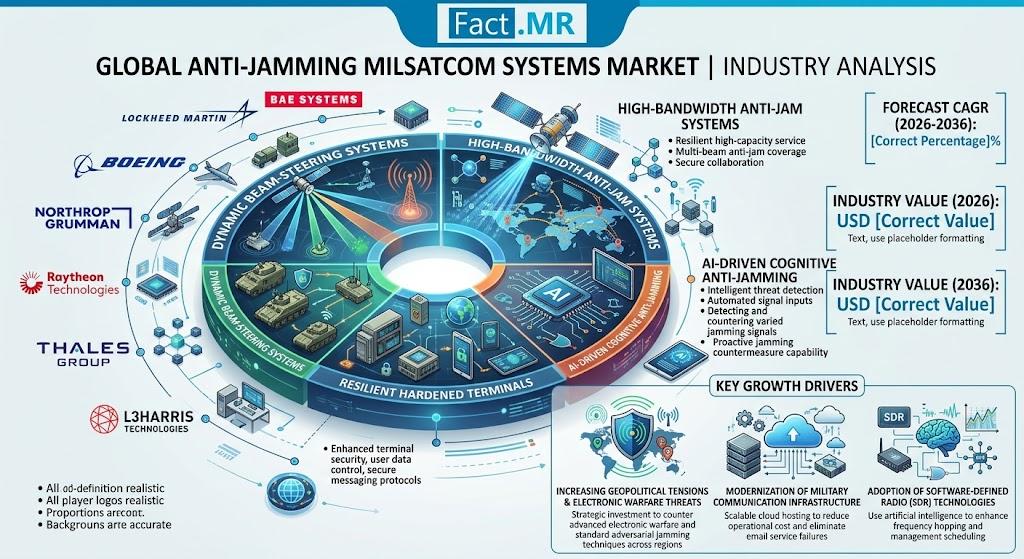
The global Anti-Jamming MILSATCOM Systems Market is projected to expand from USD 8.4 billion in 2026 to USD 27.0 billion by 2036, advancing at a 12.4% CAGR during the forecast period. The market reached USD 7.5 billion in 2025, with demand rising as armed forces strengthen satellite communications against deliberate interference in contested operating environments.
Get Detailed Market Forecasts, Competitive Benchmarking, and Pricing Trends: https://www.factmr.com/connectus/sample?flag=S&rep_id=16438
The market is expected to create an absolute opportunity of USD 18.6 billion between 2026 and 2036. Demand is being shaped by military requirements for protected tactical SATCOM, multi-band connectivity, smaller field terminals, secure waveform management, and cryptographic protection.
Protected SATCOM Becomes a Procurement Priority
Military space commands require satellite links that remain usable when hostile transmitters interfere with conventional radio-frequency paths. Naval forces are also seeking multi-band terminals capable of shifting traffic between X-band, Ka-band, and UHF across long-distance missions.
For air and land forces, terminal size and integration are becoming important procurement considerations. Protected waveforms must operate within the physical limits of existing aircraft and military vehicles.
Ground networks add another layer of demand. Cryptographic units and mission-management systems help assign network capacity while protecting waveform keys across allied users.
Recent procurement activity reflects this requirement. The U.S. Space Systems Command awarded two Protected Tactical SATCOM Ground (PTS-G) production contracts totalling USD 437.7 million in June 2026 for satellites designed to provide anti-jam communications and maintain connectivity in denied environments.
Null-Steering Phased Arrays Lead Anti-Jam Techniques
Null-steering phased arrays are expected to account for 31.0% of the market in 2026, making the technology the leading anti-jam technique covered by the report.
These systems allow antennas to suppress hostile signals while maintaining the protected communication link. This makes null steering relevant to military SATCOM architectures where directional gain and interference rejection must operate together.
A Space Systems Command demonstration in August 2025 showed Protected Tactical Waveform communications using frequency hopping at variable interference levels and over-the-air operation through five PTW-enabled terminals. The exercise demonstrated the interaction between protected waveforms, terminals, and SATCOM infrastructure in contested conditions.
Ka-Band and User Terminals Shape Deployment
Ka-band is projected to hold a 29.0% share in 2026. It remains an important part of protected military SATCOM architectures alongside X-band and UHF. UK military SATCOM planning continues to include military Ka-band for wideband requirements, while UHF serves narrowband tactical applications.
On the system-element side, user terminals are anticipated to capture 30.0% share in 2026. Terminal upgrades provide a direct route for deployed forces to access protected waveform capacity.
Many military programs continue to work around existing antennas, vehicles, ships, and aircraft. As a result, modem upgrades, waveform compatibility, cryptographic integration, and platform support can influence adoption decisions.
Fixed ground infrastructure is also significant, with fixed ground platforms estimated to represent 28.0% share in 2026. Gateways, anchor stations, and command sites manage capacity, keys, and network operations before traffic reaches mobile forces.
Procurement Programs Support Market Expansion
The market outlook is supported by protected tactical SATCOM production programs, multi-band terminal modernization, sovereign secure-SATCOM initiatives, and ground-hub upgrades.
The report identifies several areas with measurable growth impact:
- Protected tactical SATCOM production programs: +1.8% impact on CAGR
- Multi-band terminal refresh across services: +1.4%
- Sovereign and allied secure SATCOM programs: +1.2%
- Ground hub and crypto modernization: +0.8%
Opportunities include protected waveform modem upgrades, reprogrammable spaceborne crypto, and interoperable allied access to secure satellite capacity.
At the same time, long qualification and certification cycles, spectrum congestion, interference management, and sovereign-program budget timing can moderate adoption.
Australia Leads the Country Growth Range
Australia is forecast to record the highest CAGR among the countries highlighted in the report at 13.2% from 2026 to 2036. The country’s growth is linked to secure multi-orbit SATCOM planning and maritime terminal renewal.
The United States follows at 12.8%, supported by protected tactical waveform readiness and Space Force investment. Germany is projected at 12.4%, matching the global CAGR through SATCOMBw modernization.
The United Kingdom is forecast to expand at 12.1%, with SKYNET 6 renewing space, ground, and user segments. France is projected at 11.8%, supported by Syracuse IV and sovereign military communications.
Analyst Perspective
Shambhu Nath Jha, Principal Consultant at Fact.MR, said:
“Protected MILSATCOM is judged by how well the whole link survives interference. Payloads and terminals have to work together before a buyer trusts the network. Suppliers are expected to gain preference when they combine waveform proof, crypto readiness and secure control software in one deployable architecture.”
The report indicates that satellite manufacturers need to validate payload flexibility under jamming conditions, while terminal suppliers must simplify modem and waveform upgrades for deployed platforms. Crypto vendors and defence integrators also face requirements around certification, secure control, and integration across space, ground, and user segments.
Competitive Landscape
The competitive landscape includes Lockheed Martin, Northrop Grumman, L3Harris, RTX, Thales, and Viasat.
Lockheed Martin is active in secure military communications and MUOS service-life-extension work. Northrop Grumman participates through protected military SATCOM payloads and ground systems. L3Harris contributes cryptographic capabilities under the Protected Tactical SATCOM SHIELD program.
Viasat received a PTS-G Swarm 1 delivery order in June 2026 for a dual X/Ka-band mini-GEO satellite, ground stations, and operations support. Collins Aerospace supports military communications through ARC-210 radios with MUOS SATCOM and SATURN anti-jam capability, while Thales contributes Modem 21 anti-jam technology and Syracuse IV ground-segment capabilities.
Read the full Anti-Jamming MILSATCOM Systems Market report: https://www.factmr.com/report/anti-jamming-milsatcom-systems-market
Report Scope and Methodology
The Anti-Jamming MILSATCOM Systems Market covers systems designed to protect military satellite communications from deliberate interference. The assessment includes anti-jam payload capabilities, protected waveforms, phased-array null steering, spread-spectrum techniques, user terminals, satellite payloads, gateways, network-control systems, cryptographic equipment, and interference-mitigation tools.
Fact.MR's analysis draws on 120+ sources, 35+ company portfolios, 25+ countries, and more than 20 industry interviews. Primary research covers manufacturers, service providers, technology developers, distributors, and end users, while desk research incorporates government publications, company filings, trade data, technical studies, industry associations, standards, and policy sources.
Other Related Reports:
https://www.newstrail.com/baby-training-pants-market-trends/
https://www.newstrail.com/iot-node-gateway-market-growth/
https://www.newstrail.com/white-noise-machine-market-value-2036/
About Fact.MR
Fact.MR is a market research and consulting firm providing syndicated and custom research across technology, defense, automotive, chemicals, healthcare, food, and other industries. Its research combines primary interviews, secondary research, market modelling, and data validation to support business and strategic decisions.

 English
 Arabic
 French
 Spanish
 Portuguese
 Deutsch
 Turkish
 Dutch
Dutch
 Italiano
 Romaian
 Portuguese (Brazil)
 Greek
Greek
