


 About Urh Social
 Terms of Service
 Política de Privacidade
 Contact
Healthcare and Medical Devices Testing Inspection and Certification Market Growth, Analysis, Trends, Recent Developments and Forecast Analysis By Fact.MR
India’s Medical Device Regulatory Reforms Put Greater Focus on Testing, Inspection and Certification
Rockville, Maryland, United States – September 16, 2026 — India’s Ministry of Health and Family Welfare announced regulatory reforms for the medical-device sector on August 24, 2026, aimed at simplifying procedures and improving ease of doing business for manufacturers. The changes arrive as medical-device companies face increasingly detailed requirements for safety, performance, quality and market-access evidence.
The regulatory shift highlights the expanding role of third-party testing, inspection and certification providers. Fact.MR estimates the Healthcare and Medical Devices Testing, Inspection and Certification Market at USD 12.8 billion in 2026, with revenue projected to reach USD 28.9 billion by 2036, representing an 8.5% CAGR.
Get detailed market forecasts, competitive benchmarking, and pricing trends:https://www.factmr.com/connectus/sample?flag=S&rep_id=16004
Why is testing and certification becoming more important?
Medical-device development increasingly requires evidence to be assembled before a product reaches a regulatory review stage. Electrical safety, mechanical performance, biocompatibility, software validation and packaging integrity can all become part of the evidence package depending on the device and approval pathway.
Fact.MR projects Testing Services to account for 46.0% of the service-type segment in 2026, making it the largest category. Testing generally precedes inspection and certification because manufacturers need verified performance and safety results before conformity documentation can be finalized.
The regulatory environment is also becoming more complex as devices incorporate software, connectivity and artificial intelligence. A testing partner may therefore need to evaluate physical performance alongside cybersecurity, software behavior and documentation.
For manufacturers, the commercial issue is timing. Finding evidence gaps after a submission has been prepared can lead to retesting, documentation changes and delayed market entry.
Which services and applications lead demand?
Medical Device Performance Testing is projected to represent 41.0% of the application segment in 2026. Performance testing helps manufacturers establish that products operate according to intended-use requirements before approval or commercialization.
The importance of performance evidence is visible in the U.S. market. FDA's Center for Devices and Radiological Health reported that it authorized 124 novel medical devices in 2025, one of the highest annual totals in more than four decades. Fact.MR also notes that more than 1,300 AI-enabled medical devices had been authorized in the United States by the end of 2025.
These developments increase the range of testing requirements. Traditional electrical and mechanical checks remain important, while connected and software-enabled devices create additional demand for validation, cybersecurity assessment and documentation review.
Analyst Perspective
Shambhu Nath Jha, Principal Consultant at Fact.MR, said:
“Healthcare and medical device TIC providers are being judged less on test volume and more on early evidence support.”
The broader Fact.MR assessment indicates that manufacturers increasingly want laboratories that can identify evidence gaps before regulatory submission. Providers able to combine physical testing with software review and regulatory documentation support may therefore gain an advantage.
This is changing the purchasing conversation. Device manufacturers are not simply looking for laboratory capacity; they are evaluating how testing partners can fit into product-development and regulatory workflows.
Market Snapshot
- 2026 market value: USD 12.8 billion.
- 2036 projected value: USD 28.9 billion.
- Forecast CAGR, 2026–2036: 8.5%.
- Absolute opportunity: USD 16.1 billion.
- Leading service type: Testing Services, with 46.0% share.
- Leading application: Medical Device Performance Testing, with 41.0% share.
- Leading end user: Medical Device Manufacturers, with 44.0% share.
- Leading service delivery model: Laboratory-based Services, with 52.0% share.
- Leading testing technology: Mechanical & Electrical Testing, with 48.0% share.
The market is projected to create USD 16.1 billion in additional opportunity between 2026 and 2036.
What's Driving Near-Term Demand?
Regulatory evidence requirements represent the strongest identified growth driver, with Fact.MR estimating a +2.2% impact on CAGR. Device manufacturers increasingly need structured evidence before products can move through approval pathways.
Outsourced laboratory capacity contributes an estimated +1.8% impact on CAGR. External laboratories allow manufacturers to access calibrated equipment and specialized protocols without maintaining every testing capability internally.
Software and cybersecurity review is another emerging demand source, carrying an estimated +1.5% impact on CAGR. Connected medical devices can create risks that are not captured through conventional physical testing alone.
The growth of AI-enabled medical devices adds another layer. Manufacturers developing products with machine-learning or software functionality increasingly need to document performance, risk controls and validation processes alongside conventional safety evidence.
Why are laboratory-based services leading?
Laboratory-based Services are projected to hold 52.0% of the service-delivery segment in 2026. Controlled laboratory environments allow manufacturers to conduct repeatable tests using calibrated equipment and documented procedures.
Mechanical and electrical testing leads the technology segment with a 48.0% share. Medical devices must demonstrate resistance to expected loads and appropriate electrical safety, making these tests fundamental across a broad range of equipment.
However, the technology mix is widening. Software verification, electromagnetic compatibility, wireless testing and packaging-integrity assessments are becoming increasingly relevant as device architectures change.
What are the main barriers?
Submission rework is estimated to create a -1.0% impact on CAGR. Missing or incomplete evidence can require additional testing and increase the cost of regulatory preparation.
Laboratory capacity bottlenecks contribute another -0.8% impact, particularly when specialized testing facilities are operating near capacity. Manufacturers with fixed launch schedules may face difficulties securing appropriate test slots.
Approval-route documentation is also a concern. Products intended for multiple markets may require evidence to be presented according to different regulatory frameworks, increasing the administrative burden for manufacturers.
Fact.MR also identifies a shortage of skilled assessors as a longer-term restraint. Testing organizations need personnel who understand both technical standards and the regulatory context in which test results will be used.
Which countries offer the strongest growth opportunities?
The United States is projected to grow at 9.3% CAGR from 2026 to 2036, the fastest rate among the countries analyzed. Mature device-review activity and extensive outsourced testing requirements support its position.
Germany follows at 9.0% CAGR, supported by its medical-technology manufacturing base and conformity-assessment requirements. The United Kingdom is projected at 8.7%, while Japan reaches 8.3%. Canada follows at 8.0%, with France and South Korea projected at 7.7% and 7.3%, respectively.
Germany's market is also being shaped by European regulatory infrastructure. The European Commission has confirmed that the first four EUDAMED modules became mandatory from May 28, 2026, adding requirements around device registration, unique device identification, notified-body certificates and market surveillance.
The United Kingdom presents another distinct regulatory environment. MHRA's post-market surveillance requirements for medical devices placed on the Great Britain market or put into service from June 16, 2025 add another layer of compliance activity.
India's August 2026 regulatory reforms add a separate growth consideration. Easier regulatory processes could encourage domestic manufacturing and investment, potentially expanding the future addressable base for testing and certification providers.
Who leads the Healthcare and Medical Devices TIC Market?
The competitive landscape includes major global testing, inspection and certification organizations with established medical-device capabilities.
Key companies profiled by Fact.MR include TÜV SÜD AG, SGS SA, Intertek Group plc, Bureau Veritas S.A., Dekra SE, UL Solutions Inc., Eurofins Scientific SE, BSI Group and Nemko Group AS.
Recent provider activity demonstrates how certification portfolios are expanding alongside device complexity. TÜV SÜD launched an IECEE Component Certification Programme for medical-technology components in November 2025, while Intertek expanded its Medical Notified Body scope under the EU MDR in July 2025.
The competitive opportunity is moving toward integrated evidence support. Providers that combine laboratory testing with regulatory documentation, software assessment and post-market support can address a wider portion of the product lifecycle.
About the Report
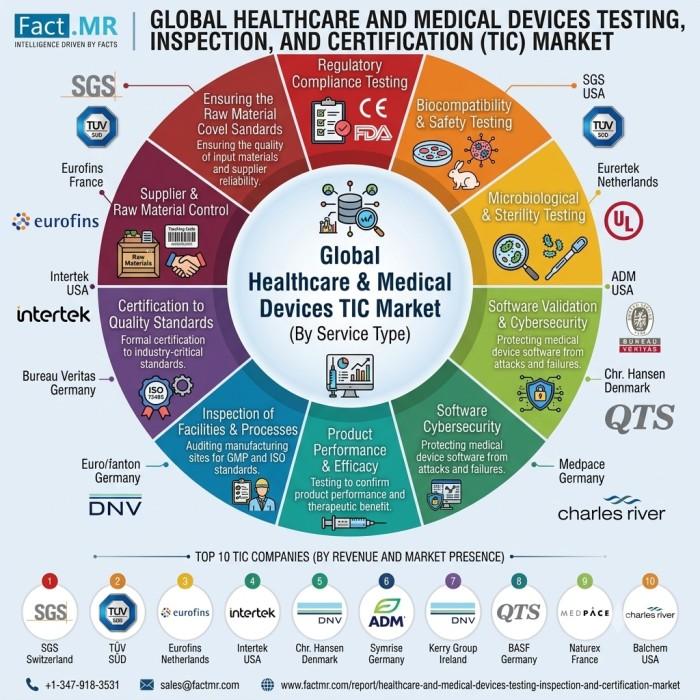
The Fact.MR study evaluates the Healthcare and Medical Devices Testing, Inspection and Certification Market across Service Type, Application, End User, Service Delivery Model and Testing Technology.
Service types include Testing Services, Inspection Services, Certification Services, Advisory and Documentation Support, and Post-market Surveillance Support.
Applications covered include Medical Device Performance Testing, Biocompatibility and Sterility Testing, Electrical Safety and EMC Testing, Software and Cybersecurity Assessment, and Regulatory Documentation Review.
End users include Medical Device Manufacturers, IVD Manufacturers, Contract Manufacturing Organizations, Hospitals and Procurement Bodies, and Digital Health Developers.
The study covers laboratory-based services, on-site inspection, remote documentation review, hybrid audit support and managed compliance programs. Testing technologies include mechanical and electrical testing, chemical and biological testing, EMC and wireless testing, software validation tools and packaging-integrity testing.
The research draws on 120+ sources, 35+ company portfolios, 25+ countries and more than 20 industry interviews. Its methodology combines primary interviews, government statistics, regulatory publications, company information, technical research, market sizing, forecasting and data validation.
Explore More Related Studies Published by Fact.MR Research:
Medical and Pharmaceutical Dynamic Sealing Solutions Market: https://www.openpr.com/news/4597508/trelleborg-leads-as-usa-medical-and-pharmaceutical-dynamic
Artificial Intelligence in Hospital Operations Market: https://www.openpr.com/news/4597510/u-s-health-systems-and-microsoft-drive-ai-hospital-operations
Artificial Intelligence in Life Sciences Market: https://www.openpr.com/news/4597511/usa-ai-in-life-sciences-market-expands-as-iqvia-rolls-out-new
Medical Devices Electronic Data Interchange Market: https://www.openpr.com/news/4597525/opentext-scales-u-s-medical-device-edi-networks-as-market
Medical Device and Medtech Enterprise Resource Planning Market:https://www.openpr.com/news/4597512/sap-se-takes-15-2-share-as-u-s-medical-device-medtech-erp
About Fact.MR
Fact.MR is a market research and consulting firm providing industry intelligence across consumer goods, food and beverages, healthcare, technology, chemicals and materials, industrial goods and other sectors. Its research process combines primary industry interviews with secondary data, company information, government sources and industry publications to develop market estimates and forecasts.
Media Contact
Fact.MR
11140 Rockville Pike, Suite 400
Rockville, MD 20852, United States
Tel: +1 (628) 251-1583
Email: [email protected]
Disclosure: This release is based on FMI syndicated research. Market figures represent estimates and forecasts available as of the publication date and may be revised as additional information becomes available.

 English
 Arabic
 French
 Spanish
 Deutsch
 Turkish
 Dutch
Dutch
 Italiano
 Russian
 Romaian
 Portuguese (Brazil)
 Greek
Greek
