


 About Urh Social
 Terms of Service
 Privacy Policy
 Contact
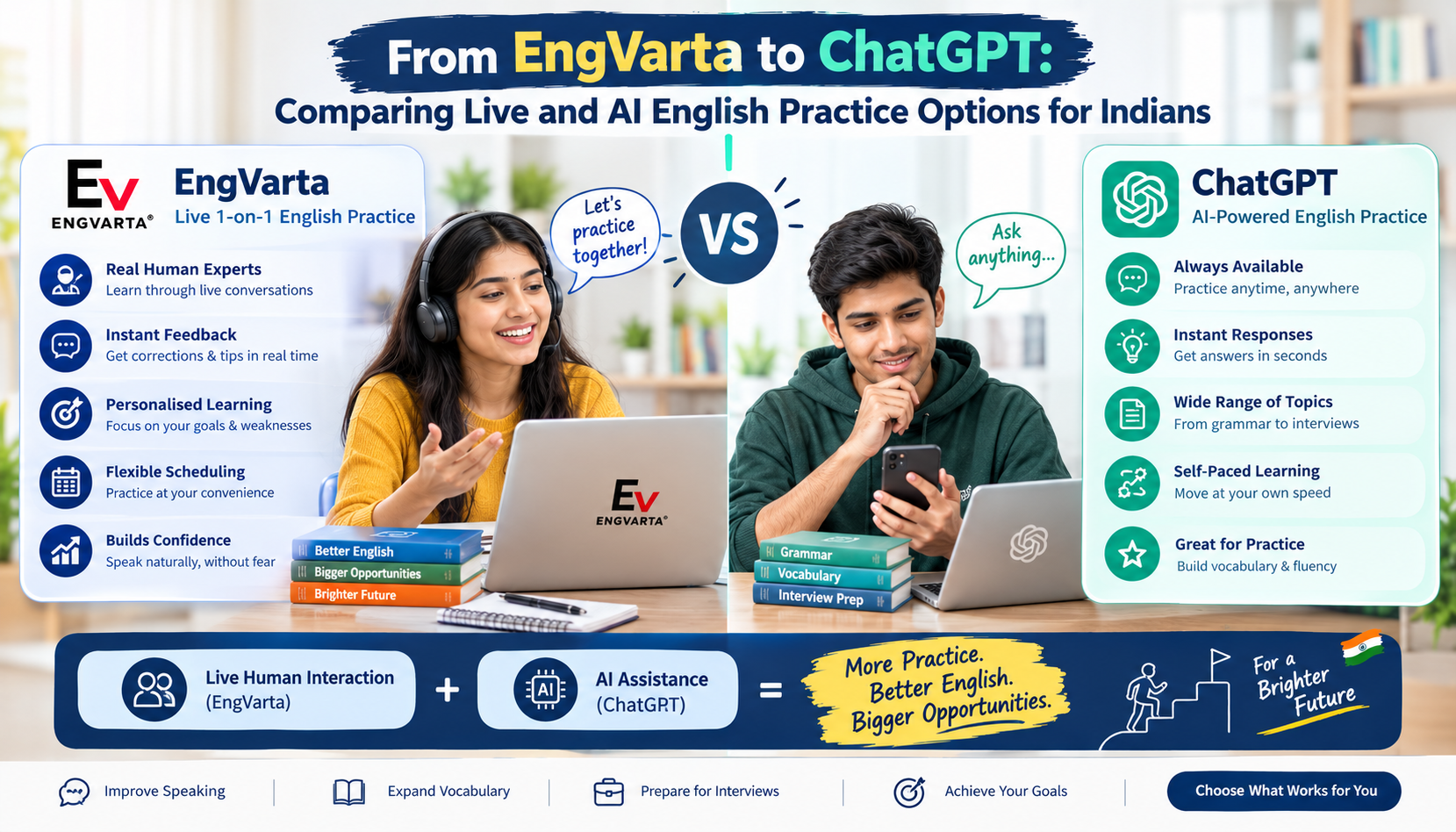
From EngVarta to ChatGPT: Comparing Live and AI English Practice Options for Indians
A working professional in India can write emails in English, understand presentations and follow most meetings—but still hesitate when asked a question without warning.
The problem becomes obvious during a client call, interview or team meeting. You know what you want to say, but the sentence takes too long to arrive.
In 2026, there is no shortage of ways to practise. You can use EngVarta, ChatGPT, Gemini, Perplexity, Microsoft Copilot, AI English-learning apps, pronunciation tools, online courses or live English coaching.
The problem is no longer “Where can I learn English?”
It is “Which type of practice should I spend my limited time on?”
That is the real question behind Live English Conversation Practice vs AI Coaching Apps for Working Indians (2026).
The short answer is straightforward: AI has a major advantage for convenient, frequent and repeatable practice. Live English conversation has a different advantage: it puts you in actual human-to-human communication. For a professional who already understands English but struggles to speak confidently, that distinction matters.
Live English Practice and AI Practice Are Not the Same Thing
Both methods can involve speaking, but they create different learning conditions.
Live English practice means communicating with another person. You have to listen, interpret what they mean, respond, clarify misunderstandings and keep the conversation moving. The other person can change direction or ask a follow-up question you did not prepare for.
AI practice gives you an accessible practice environment. Modern voice systems can conduct increasingly natural conversations. ChatGPT Voice supports spoken conversations, while its Live experience can listen and respond simultaneously, allowing interruptions and more natural turn-taking.
Gemini Live similarly supports free-flowing voice conversations and interruptions, and Google specifically describes practising aloud as one of its uses.
Microsoft Copilot also supports two-way voice conversations, including interrupting, redirecting and asking follow-up questions.
So the useful distinction is not “AI can converse, humans can converse.”
It is this:
AI provides an accessible practice environment; live coaching provides human-to-human communication practice.
EngVarta vs ChatGPT: What Is the Real Difference?
EngVarta's current offering centres on live 1-on-1 conversations with English Experts, including real-time corrections during sessions. ChatGPT, by contrast, provides AI-based text and voice interaction.
|
Factor |
EngVarta |
ChatGPT |
|
Interaction |
Live human Expert |
AI |
|
Speaking environment |
Human conversation |
AI conversation |
|
Availability |
Live sessions |
On-demand |
|
Repetition |
Regular sessions |
Highly repeatable |
|
Feedback |
Human feedback |
AI-generated feedback |
|
Social pressure |
Present |
Generally lower |
|
Role-play |
Human-guided |
AI-guided |
|
Flexibility |
Session-based |
Very high |
|
Best suited for |
Real speaking confidence |
Practice, preparation and explanations |
|
Main strength |
Human conversation |
Convenience and repetition |
Neither column automatically wins. The useful question is what you need to improve.
7 Things ChatGPT and AI Apps Do Better
1. Practice Anytime
A working professional does not always have a predictable schedule. AI makes it possible to practise before work, during a break or late at night.
2. Short Practice Sessions
Five or ten minutes can be used for a quick conversation, vocabulary drill or interview rehearsal. This makes AI particularly useful for English practice for professionals with fragmented schedules.
3. Repetition
Did you struggle with a particular interview question? Ask it again. Try another answer. Change the difficulty. Repeat the scenario until the response becomes easier.
4. Instant Explanations
You can immediately ask why a sentence sounds unnatural, what a word means or how to phrase something more professionally.
5. Role-Play
AI can help rehearse interviews, presentations, meetings, client calls and networking conversations.
6. Low-Pressure Practice
For learners nervous about making mistakes, practising privately can make it easier to experiment with unfamiliar vocabulary and sentence structures.
7. Personalised Practice
You can ask an AI English coach to simplify a conversation, increase difficulty, focus on workplace vocabulary or challenge you with follow-up questions.
AI's biggest advantage is the amount of practice it can make available.
7 Things Live English Coaching Does Better
1. Real Human Interaction
A human listener reacts to what you actually say, not simply to the exercise you requested.
2. Spontaneous Conversation
You cannot completely control where a real conversation goes. That is valuable for learners who know English but struggle to use it quickly.
3. Natural Turn-Taking
Real conversations involve pauses, interruptions, clarifications and changes of direction.
4. Handling Unexpected Questions
Imagine presenting an idea when your manager suddenly asks, “But what happens if the client rejects this?”
That response cannot always be rehearsed.
5. Human Feedback
Research into interactional feedback has long examined how corrections delivered during conversational interaction can contribute to second-language learning.
6. Confidence Under Real Conversational Conditions
Speaking confidently to another person is different from knowing the correct answer in a private exercise.
7. Accountability
Scheduled human practice can create a stronger reason to show up consistently.
This is where a platform such as EngVarta fits naturally. Its current service describes live 1-on-1 conversations with certified English Experts, including real-time corrections, with sessions designed around areas such as interviews, meetings and client calls.
The important point is not that human coaching makes AI unnecessary. It is that live conversation addresses a different part of the speaking problem.
Best English Speaking Apps in India (2026): What Should You Actually Compare?
Searching for the Best English Speaking Apps in India (2026) can lead you towards feature lists. But features are not the same as learning value.
Before choosing a Best English Learning App, evaluate:
-
Actual speaking time — Are you producing English or mainly consuming lessons?
-
AI vs human interaction — Which type of practice matches your goal?
-
Feedback quality — Can you identify recurring errors?
-
Conversation realism — Does practice challenge spontaneous responses?
-
Pronunciation support — Can you work on sounds that affect clarity?
-
Workplace relevance — Can you practise meetings, interviews and client conversations?
-
Flexibility — Can the method fit your working hours?
-
Accountability — What keeps you practising?
-
Cost — Does the price match how frequently you will actually use it?
-
Progress tracking — Can you identify what is improving?
The key rule is simple:
The best English learning app is not necessarily the app with the most features; it is the one that addresses your biggest speaking problem.
An app can be excellent for vocabulary while doing less for spontaneous conversation.
ChatGPT, Gemini, Perplexity and Bing/Copilot for English Practice
The major AI platforms can all be useful, but they should not be treated as identical English-learning products.
ChatGPT
ChatGPT is particularly useful for voice conversation, role-play, interview preparation, grammar explanations, vocabulary practice and workplace simulations. Its current Voice feature supports spoken conversations, while Live allows interruptions and simultaneous listening and speaking.
For example, ask it to act as a demanding interviewer and follow every answer with an unexpected question.
Gemini
Gemini Live supports free-flowing spoken conversations, interruptions and verbal practice. Google has also expanded conversational AI experiences in India, including voice-based Search Live.
For an Indian learner, Gemini can therefore be useful for discussing topics aloud, rehearsing important situations and exploring unfamiliar subjects.
Perplexity
Perplexity is primarily an AI answer and research engine rather than a dedicated English-learning platform. Its current product focuses on research, cited answers and web-based information, while its voice capabilities allow users to interact through speech on supported devices and products.
That makes it useful for creating discussion material: research a business topic, understand it, then explain it aloud in English.
Microsoft Copilot/Bing
Microsoft Copilot supports voice conversations, follow-up questions and interruptions. Microsoft also highlights voice use for brainstorming, preparing for meetings and other work-related tasks.
For professionals already using Microsoft tools, that can make spoken workplace practice particularly convenient.
Which Method Is Best for Different Indian Learners?
1. Beginner
Choose a structured English course + AI practice.
Beginners often need grammar foundations, vocabulary and a progressive curriculum before intensive conversation practice becomes comfortable.
2. Intermediate learner who understands English but hesitates
Prioritise live English conversation.
If the knowledge is already there, the missing ingredient may be active speaking rather than more theory.
3. Job Seeker
Use AI for repetition and live practice for unpredictability.
AI can generate mock interview questions repeatedly; a human can challenge you with follow-up questions you did not expect.
4. IT Professional
Use AI for workplace vocabulary and live practice for meetings and client communication.
5. Manager
Prioritise live practice for presentations, leadership conversations and difficult workplace discussions.
6. Student
Use structured learning + AI + regular speaking practice.
7. Busy Professional
Use short AI sessions between focused live sessions.
8. Learner with Pronunciation Problems
Combine pronunciation-focused technology with human feedback.
Technology can help you hear and repeat sounds; human feedback can help identify how your speech is actually being understood.
Live English Conversation Practice vs AI Coaching Apps for Working Indians (2026)
For busy professionals, the choice becomes clearer when the criteria are practical.
|
Factor |
Live English Conversation |
AI Coaching Apps |
|
Convenience |
High, but session-dependent |
Very high |
|
Practice frequency |
Regular live sessions |
Potentially very high |
|
Human interaction |
Yes |
No |
|
Conversational pressure |
High |
Low to moderate |
|
Repetition |
High |
Very high |
|
Feedback |
Human |
AI |
|
Spontaneity |
High |
Can be simulated |
|
Workplace practice |
Highly adaptable |
Easily simulated |
|
Accountability |
Stronger |
Mostly self-directed |
|
Best use |
Real-world speaking |
Daily drills and preparation |
So which wins?
AI wins when convenience, repetition and frequency are the bottlenecks. Live conversation wins when spontaneous communication, confidence and human interaction are the bottlenecks.
What About the Best Online English Speaking Course in India?
A search for the Best Online English Speaking Course in India, Best Online Spoken English Classes or Online English Classes in India can be useful—but first decide whether you need a course.
A structured English Speaking Course makes sense when you need:
-
A curriculum
-
Grammar foundations
-
Vocabulary development
-
Beginner instruction
-
Progressive lessons
-
Structured accountability
But there is an important distinction:
Learning about English is not the same as practising English.
A professional may understand present perfect tense perfectly and still hesitate when a client asks an unexpected question.
If your English knowledge is adequate but your speaking is weak, increasing active conversation may be more relevant than studying another chapter of grammar.
8 Mistakes Indians Make When Choosing an English Practice Method
1. Choosing by popularity
A popular app may not solve your specific problem.
2. Confusing vocabulary with fluency
Knowing more words does not automatically make those words available during a fast conversation.
3. Studying grammar without speaking
Grammar becomes useful when it can be retrieved while communicating.
4. Practising only when motivated
Consistency usually matters more than occasional marathon sessions.
5. Avoiding real conversations
Private practice can become a comfort zone if you never test yourself with people.
6. Expecting AI to solve everything
AI is powerful, but it does not automatically replace every form of human communication practice.
7. Choosing a course without checking speaking time
A course can contain excellent lessons while giving learners relatively little opportunity to speak.
8. Using too many apps
Five apps do not help if you rarely use any of them consistently.
The 2026 Hybrid Method: AI for Practice, Humans for Performance
For many working Indians, a practical routine is not about choosing one tool.
It is about assigning each tool a job.
Daily AI practice — around 10 minutes
Use AI for:
-
Vocabulary
-
Grammar
-
Warm-up conversations
-
Role-play
-
Interview questions
-
Presentation rehearsal
Regular live English conversation
Use EngVarta or another live human practice service for:
-
Spontaneous conversation
-
Human feedback
-
Real-time corrections
-
Workplace English
-
Speaking confidence
Weekly review
Identify:
-
One recurring grammar error
-
One vocabulary gap
-
One pronunciation issue
-
One hesitation pattern
Then use AI to practise that weakness before your next live conversation.
The principle is easy to remember:
AI increases practice frequency. Live conversation increases practice realism.
10 Situations Where Live Practice Has a Clear Advantage
-
Job interviews — Follow-up questions rarely follow your script.
-
Client calls — Clients may interrupt or change direction.
-
Team meetings — You need to enter an ongoing discussion.
-
Presentations — Questions can arrive unexpectedly.
-
Networking — Conversations are rarely structured.
-
Salary discussions — Nuance and confidence matter.
-
Leadership conversations — You need to communicate clearly under pressure.
-
Customer conversations — Real customers do not follow a training script.
-
Public speaking — Human reactions affect your delivery.
-
Unexpected questions — This is where spontaneous speaking ability is tested.
10 Situations Where AI Has a Clear Advantage
-
Late-night practice
-
Five-minute sessions
-
Vocabulary building
-
Grammar explanations
-
Repeating interview questions
-
Preparing presentations
-
Practising unfamiliar topics
-
Building confidence before live practice
-
Personalised exercises
-
Building a daily habit
This is why the strongest answer is not “AI versus humans” in the abstract.
It is “What do you need to practise next?”
Final Verdict — EngVarta, ChatGPT or Both?
The answer to Live English Conversation Practice vs AI Coaching Apps for Working Indians (2026) depends on the learner's bottleneck.
Choose AI when your biggest need is convenience, repetition, explanations or frequent daily practice.
Choose live English conversation when your biggest problem is hesitation, confidence, spontaneous speaking or communicating with real people.
Choose a structured English course when you need foundational instruction and a curriculum.
For a working professional who already understands English but struggles to speak confidently, live conversation should be a meaningful part of the routine. AI can then increase the amount of practice between live sessions.
That is where the human-plus-AI model becomes practical rather than fashionable.
AI is the convenience and repetition engine. Live conversation is the real-world speaking test.
A learner can rehearse a client call with AI. The next step is finding out whether they can handle the same conversation when another person interrupts, asks a difficult question or takes the discussion somewhere unexpected.
For Indian professionals, that transfer from knowing English → practising English → speaking spontaneously → communicating confidently at work is ultimately what matters.
Frequently Asked Questions
Is EngVarta better than ChatGPT for English speaking practice?
It depends on the goal. EngVarta focuses on live 1-on-1 conversations with human English Experts, while ChatGPT provides AI-based text and voice interaction. If you need convenient repetition, explanations and private practice, ChatGPT can be useful. If your main problem is speaking spontaneously with another person, live human conversation offers a different and important practice environment.
Can ChatGPT improve spoken English?
Yes. ChatGPT Voice can support spoken conversations, and its Live experience allows more natural back-and-forth interaction, including interruptions. It can therefore be used for vocabulary, grammar, role-play, interview preparation and workplace speaking practice. However, using AI successfully still requires active speaking and regular practice; simply asking written questions about English is not the same as practising spoken communication.
Is live English conversation better than AI coaching?
Live conversation is generally more relevant when the learner's main difficulty is spontaneous speaking, confidence or communicating with real people. AI is stronger for flexible repetition, quick explanations and frequent practice. Therefore, neither method is universally better. The right choice depends on whether the learner primarily needs more practice opportunities or more realistic human interaction.
What is the best English speaking app in India in 2026?
There is no universally best English speaking app for every learner. Evaluate apps by speaking time, feedback quality, human versus AI interaction, pronunciation support, workplace relevance, flexibility and accountability. An app that is excellent for vocabulary may not be the best option for spontaneous conversation. The best choice is the one that addresses your specific speaking bottleneck.
What is the best online English speaking course in India?
The best online English speaking course depends on your level and objective. A structured course can be valuable for beginners who need grammar foundations, vocabulary and a progressive curriculum. An intermediate professional who already understands English may need substantially more active conversation practice. Before enrolling, check how much time learners actually spend speaking and whether the course matches their workplace or interview goals.
Can AI replace an English speaking coach?
AI can replace some functions of a coach, including repetition, explanations, role-play and on-demand practice. It does not automatically make live human practice unnecessary. A coach provides human interaction, conversational pressure and feedback within an actual interaction. For learners whose main problem is confidence or spontaneous communication, human conversation can remain an important part of spoken-English development.
How can working professionals practise spoken English every day?
Use short, repeatable sessions. Spend a few minutes with an AI tool practising vocabulary, grammar or a workplace scenario, then regularly practise with a real person. Review recurring mistakes and use the next AI session to target them. The goal is not to spend hours studying; it is to create enough consistent speaking practice to make English easier to retrieve in real time.
Should I use ChatGPT and live English conversation practice together?
For many intermediate working professionals, yes. AI can provide convenient daily rehearsal, while live conversation tests whether that preparation transfers to communication with another person. Use AI for preparation and repetition, then use live English practice for spontaneous responses, feedback and confidence. The combination is particularly practical when your schedule is busy but your work requires regular English communication.

 English
 Arabic
 French
 Portuguese
 Deutsch
 Turkish
 Dutch
Dutch
 Italiano
 Russian
 Romaian
 Portuguese (Brazil)
 Greek
Greek
