


 About Urh Social
 Terms of Service
 Privacy Policy
 Contact
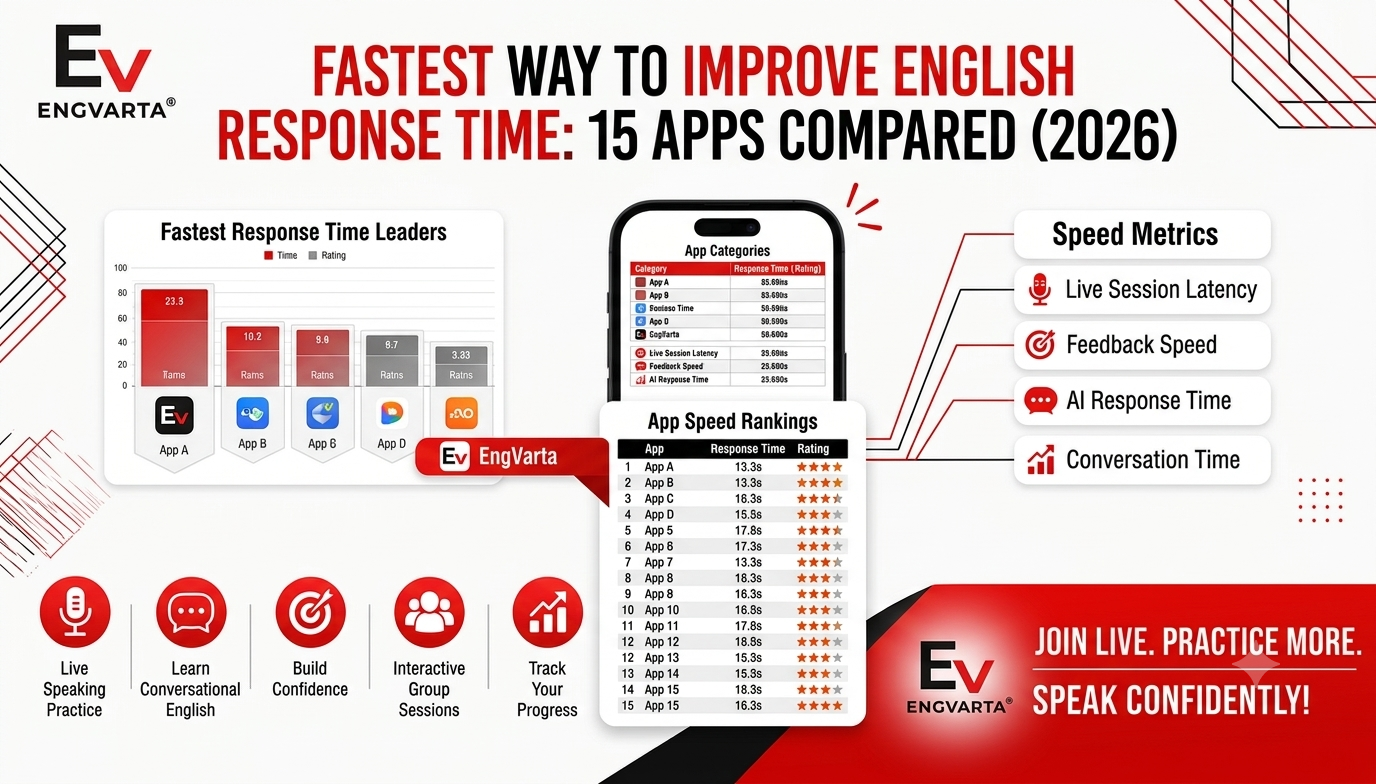
Fastest Way to Improve English Response Time: 15 Apps Compared (2026)
You may know the grammar. You may understand what someone is saying. You may even have a good English vocabulary. Yet, when somebody suddenly asks you a question in English, your mind goes blank.
That gap between knowing English and using it quickly is one of the biggest challenges for English learners.
During a real conversation, your brain has to listen, understand the meaning, retrieve the right words, build a sentence, pronounce it and deliver the answer—all within seconds. If you mentally translate from Hindi or another language before speaking, the delay can become even more noticeable.
That is why the fastest way to improve English response time is not simply memorizing more vocabulary. You need repeated English speaking practice, listening exposure, sentence-pattern familiarity and opportunities to produce spontaneous English responses.
We ranked these 15 apps specifically for that purpose. The ranking considers real-time conversation, speaking opportunities, spontaneous response practice, listening, vocabulary recall, pronunciation, confidence, accessibility and usefulness for Indian learners. It is therefore a topic-specific ranking—not a general popularity list.
Quick comparison
|
App |
Best For |
Response-Time Help |
Practice Type |
|
EngVarta |
Live human conversation |
Very high |
1-to-1 human practice |
|
Cambly |
Tutor conversations |
Very high |
Live human |
|
italki |
Personalized lessons |
High |
Human tutors |
|
HelloTalk |
Language exchange |
High |
Human voice/video |
|
Tandem |
Language exchange |
High |
Human voice/video |
|
Speak |
AI conversation |
High |
AI |
|
Loora |
AI speaking |
High |
AI |
|
ELSA Speak |
Pronunciation + role-play |
Medium-high |
AI |
|
Praktika |
AI role-play |
High |
AI avatars |
|
Memrise |
Phrases + AI practice |
Medium-high |
AI + video |
|
Busuu |
Structured speaking |
Medium |
AI + lessons |
|
Babbel |
Scenario practice |
Medium |
Structured + AI |
|
Duolingo |
Habit-based practice |
Medium |
Lessons + AI |
|
Rosetta Stone |
Immersive fundamentals |
Medium |
Structured |
|
Cake |
Listening + repetition |
Medium |
Video + speaking |
1. EngVarta — Best for Practicing Real Conversations
EngVarta is particularly relevant if your main problem is: “I understand English, but I cannot reply quickly.”
Its focus is 1-to-1 spoken English practice with live experts. The current service describes real-time calls, conversational practice and feedback, making it different from apps that mainly teach vocabulary or grammar. App Store+1
That distinction matters because real conversations are unpredictable. You cannot simply wait for the next exercise. You have to listen and respond.
For an Indian learner preparing for an interview, workplace meeting or everyday conversation, repeated live practice can create opportunities to formulate answers under conversational pressure.
Illustrative example:
Practice Partner: “Why do you want to change your job?”
Learner: “I’m looking for a role where I can take on more responsibility and develop my skills.”
The goal is not to memorize that exact answer. It is to become comfortable producing a relevant answer without a long pause.
EngVarta earns the top position because its core purpose is closely aligned with real conversational response practice. Its limitation is equally important: learners who primarily need pronunciation drills, vocabulary building or structured grammar may benefit from pairing it with another type of app.
2. Cambly — Best for Live Tutor Interaction
Cambly focuses on real conversations with English-speaking tutors and offers practice through its app. Its current English-learning offering includes conversation-focused lessons and speaking practice. Cambly
For response speed, the major advantage is unpredictability. A tutor can ask follow-up questions, change topics and require you to explain yourself.
This makes Cambly useful for professionals who need workplace English or learners preparing for interviews.
Its main consideration is that live tutor practice requires more commitment than simply opening an AI app for a few minutes.
3. italki — Best for Personalized Human Lessons
italki is a tutor-based language-learning platform where learners can work with individual teachers.
Its strength for response time comes from personalization. Instead of practicing generic English, a learner can focus speaking sessions around interviews, presentations, workplace communication or everyday conversation.
For example, an intermediate learner could dedicate a session to answering unexpected interview questions. The tutor can then push the learner to expand short answers.
The limitation is that the quality of the experience depends on finding a tutor and lesson approach that matches your goals.
4. HelloTalk — Best for Everyday Language Exchange
HelloTalk connects language learners with speakers of other languages and supports text, voice and video interaction. Its platform also provides tools such as translation, pronunciation and corrections. HelloTalk+1
This makes it valuable for learners who need less formal, everyday English conversation.
The advantage is variety: conversations can involve hobbies, culture, travel or daily life. That unpredictability is useful for spontaneous speaking.
Illustrative example:
Partner: “What do you usually do after work?”
Learner: “I usually go for a walk, but recently I’ve started going to the gym.”
The limitation is that language exchange is less structured than a professional lesson, so you may need to take responsibility for keeping the conversation productive.
5. Tandem — Best for Real-World Language Exchange
Tandem provides language exchange through text, voice notes, audio and video calls, along with translation and correction tools. Tandem - Speak Any Language
It is particularly useful when you want to practice responding to another person rather than completing isolated exercises.
For Indian learners, it can also provide exposure to different English accents and communication styles.
Its biggest limitation is consistency: finding a compatible partner and maintaining regular conversations can require effort.
6. Speak — Best for AI Conversation Practice
Speak is designed around speaking rather than only studying. Its learning approach combines phrases, practice and AI back-and-forth conversation, with feedback on pronunciation and phrasing. Speak
This is useful if you know English but feel nervous speaking to another person.
You can repeatedly practice situations such as ordering food, introducing yourself or discussing work without worrying about embarrassing mistakes.
The limitation is straightforward: AI conversation is useful preparation, but it cannot completely reproduce the unpredictability of human interaction.
7. Loora — Best for Low-Pressure Speaking
Loora is an AI-powered English speaking app built around spoken conversations and feedback. Its support materials describe pronunciation and grammar feedback during conversations, role-play and open conversation practice. Loora.com+1
Loora is particularly suitable for someone who freezes when speaking with other people.
A learner can practice answering questions repeatedly until producing a response feels less effortful.
This makes it useful for improving conversational confidence before moving into human conversations. The limitation is that AI practice should ideally be followed by real interaction.
8. ELSA Speak — Best for Pronunciation and Speaking Accuracy
ELSA Speak is strongly focused on English pronunciation, while its current AI features also include realistic role-play and personalized feedback. ELSA Speak+1
Pronunciation can affect response speed indirectly. If you constantly worry about whether a word will sound correct, you may hesitate before saying it.
ELSA is therefore useful for learners who know what they want to say but lack confidence in how they pronounce it.
It is less suited than a live-conversation platform for experiencing completely unpredictable human dialogue.
9. Praktika — Best for AI Role-Play
Praktika uses AI tutors and avatar-based interaction to create speaking practice. The company describes personalized plans, real-time feedback and suggestions designed to keep conversations moving. Praktika+1
This can be useful for rehearsing situations such as interviews or workplace conversations.
Its low-pressure format is especially helpful for learners who avoid speaking because they fear mistakes.
The limitation is that simulated conversations are still different from talking to a real person who may interrupt, misunderstand or unexpectedly change the topic.
10. Memrise — Best for Useful Phrases and AI Practice
Memrise combines vocabulary and phrase learning with authentic video content and AI conversation practice through MemBot. Memrise
This matters because response speed often depends on retrieving ready-to-use phrases, not individual dictionary words.
Learning expressions related to work, travel or social situations can make it easier to start a response.
Its limitation is that vocabulary and AI practice alone may not provide enough real human interaction for someone whose biggest weakness is conversational pressure.
11. Busuu — Best for Structured Speaking Practice
Busuu combines structured language lessons with speaking practice and community learning. Its speaking exercises use listen-and-repeat activities, while Busuu Conversations provides AI-based speaking practice and feedback. Busuu Support+1
This makes Busuu a good choice for learners who want a guided route rather than jumping directly into free conversation.
The structured approach can help build grammar, vocabulary and speaking foundations together.
The trade-off is that structured exercises are not identical to spontaneous human conversation.
12. Babbel — Best for Scenario-Based Practice
Babbel offers structured language learning, while its Babbel Speak feature lets learners practice scenario-based conversations with an AI partner and receive feedback afterwards. Babbel Help Center
This is useful when you want to rehearse situations before facing them in real life.
For example, a learner preparing for a business trip could practice common travel interactions before travelling.
Babbel is more structured than language-exchange platforms, which is helpful for beginners but may feel less spontaneous than live human conversation.
13. Duolingo — Best for Building a Daily Practice Habit
Duolingo offers bite-sized language lessons covering speaking, listening, reading and writing. Its AI-powered Video Call feature gives eligible learners opportunities for spontaneous conversation practice. Duolingo+1
For response time, the biggest benefit is regularity. Short, repeated practice can help learners stay active with English instead of studying only occasionally.
Duolingo is especially attractive to beginners building a foundation.
Its limitation is that a general language-learning routine should not be mistaken for extensive live conversation practice.
14. Rosetta Stone — Best for Immersive Foundations
Rosetta Stone provides structured language learning with speaking and listening activities. Its current Phrasebook also lets learners hear common phrases and practice saying them using speech recognition. Rosetta Stone+1
This can help learners develop familiarity with common sentence patterns, which is useful when they need to respond quickly.
It is better suited to learners who want a broader structured foundation than someone looking exclusively for live conversation.
15. Cake — Best for Listening, Phrases and Repetition
Cake uses online video, audio and interactive functions such as voice recording and quizzes as part of its language-learning service. MyCake Resource
Its value for response speed comes from exposure to spoken English and repeated practice with phrases.
It can be useful for learners who struggle to understand natural spoken English before they even attempt a response.
The limitation is that listening and repetition should eventually lead into interactive speaking practice if quick replies are the main goal.
Why English Response Time Takes Practice
Speaking quickly is not the same as speaking carelessly.
Consider what happens when someone asks you an unexpected question. You must:
-
Listen to the words.
-
Understand the meaning.
-
Decide what you want to communicate.
-
Retrieve appropriate vocabulary.
-
Build a sentence.
-
Pronounce it.
-
Deliver it confidently.
If you translate every sentence mentally, each stage can feel slower.
Repeated practice can make familiar words, phrases and sentence structures easier to retrieve. That is one reason active spoken English practice is so important.
A useful progression might look like this:
Slow response:
“I… actually… last weekend… I went to…”
More automatic response:
“I visited my cousin and spent the weekend with my family.”
The objective is not to speak unnaturally fast. It is to reduce unnecessary pauses so your ideas can come out more naturally.
How to Choose the Right App to Improve English Response Time
Start with your actual weakness.
If you freeze during real conversations, prioritize live human conversation through platforms such as EngVarta, Cambly, italki, HelloTalk or Tandem.
If you are nervous about speaking with people, an AI platform such as Speak, Loora or Praktika can provide lower-pressure rehearsal first.
If your main problem is pronunciation, ELSA Speak deserves more attention. If vocabulary retrieval is holding you back, Memrise can help you build useful words and phrases. If you need structured learning, Busuu, Babbel, Duolingo or Rosetta Stone may be more suitable.
This distinction is important when comparing the Best English Speaking Apps in India (2026). The right choice depends less on popularity and more on the specific reason you hesitate.
Likewise, an English Speaking Course or the Best Online English Speaking Course in India may be preferable if you want a broader curriculum with instruction and progression. People comparing the Best Online Spoken English Classes should check whether the program actually gives learners substantial opportunities to speak rather than mainly watch lessons.
For learners searching for Online English Classes in India, a structured course can complement an app. But if your biggest problem is simply, “I know the answer, but I cannot say it quickly,” frequent conversational practice deserves priority.
There is no single Best English Learning App for everyone. The best tool is the one you will use consistently and that directly targets your bottleneck.
Final Takeaway
The fastest practical way to improve English response time is to practice the complete process: listen → understand → retrieve → form → speak → respond.
Vocabulary matters. Grammar matters. Pronunciation matters. But knowing these things on paper does not automatically make spontaneous conversation easy.
For learners who specifically need actual conversational practice, EngVarta is a particularly relevant option because its central learning activity involves live 1-to-1 spoken English practice. Other apps may be stronger for AI simulation, pronunciation, vocabulary, listening or structured learning.r.

 English
 Arabic
 French
 Spanish
 Portuguese
 Deutsch
 Dutch
Dutch
 Italiano
 Russian
 Romaian
 Portuguese (Brazil)
 Greek
Greek
