


 About Urh Social
 Terms of Service
 سياسة الخصوصية
 Contact
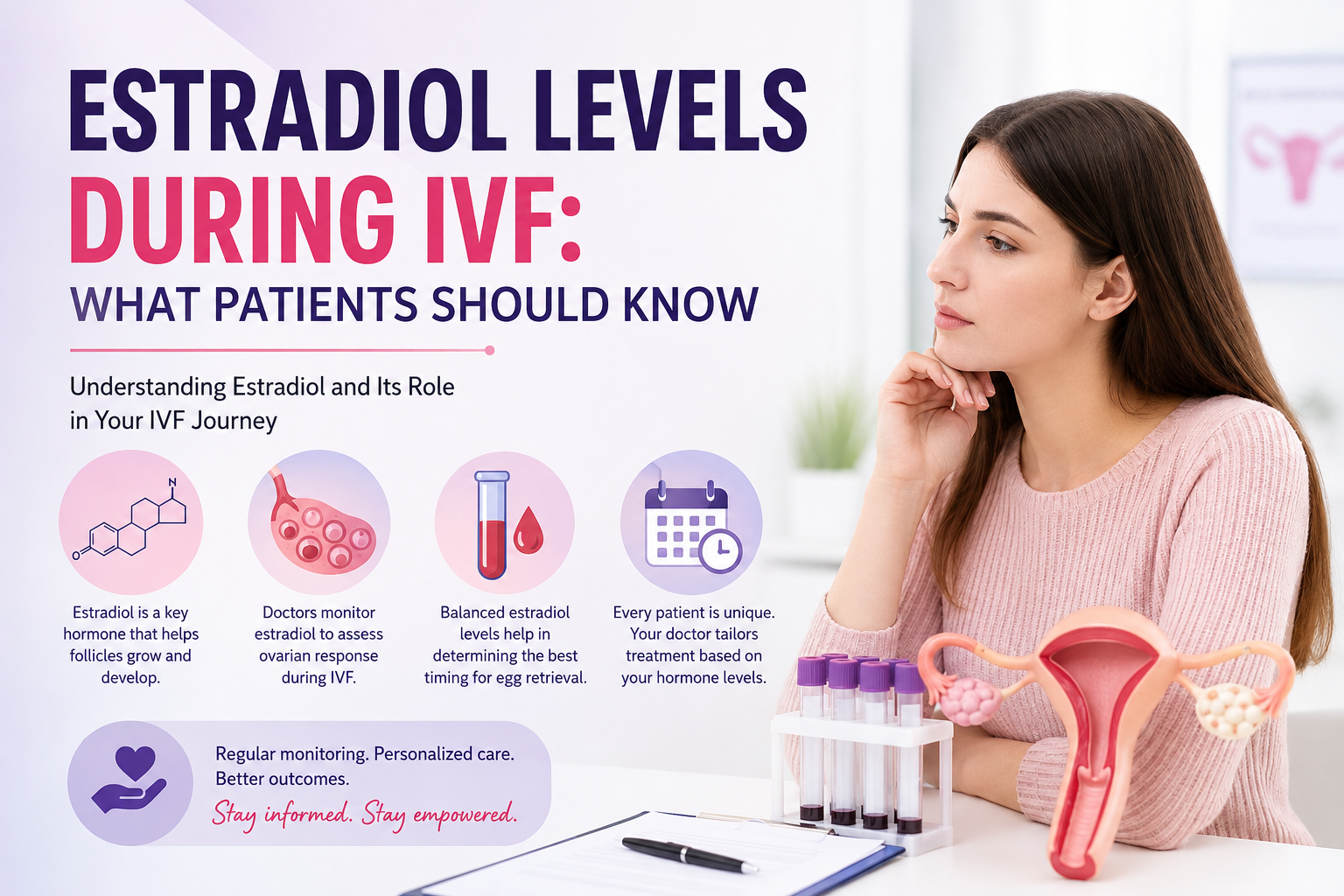
Estradiol Levels During IVF: A Patient Guide
Introduction
Going through IVF can feel like watching a carefully planned process unfold one step at a time. Among the many blood tests involved, estradiol (E2) is one that patients often hear about but may not fully understand.
Why does estradiol matter during IVF? What do changing levels tell your fertility team? And does a higher estradiol level always mean better chances of pregnancy?
The answer is more nuanced than a single number. Estradiol helps doctors understand how your ovaries are responding to stimulation and helps them decide how to manage the IVF cycle safely and effectively.
If you are undergoing treatment, an IVF Specialist Doctor in New Delhi can assess your estradiol results alongside ultrasound findings, follicle development, age, ovarian reserve, medications, and other factors..
Table of Contents
| Sr# | Headings |
|---|---|
| 1 | What Is Estradiol? |
| 2 | Why Is Estradiol Important During IVF? |
| 3 | How Estradiol Changes During an IVF Cycle |
| 4 | Estradiol Levels Before IVF Stimulation |
| 5 | Estradiol Levels During Ovarian Stimulation |
| 6 | What Does a High Estradiol Level Mean? |
| 7 | What Does a Low Estradiol Level Mean? |
| 8 | Estradiol and Follicle Development |
| 9 | How Doctors Monitor Estradiol During IVF |
| 10 | Does Estradiol Predict the Number of Eggs? |
| 11 | Estradiol and OHSS Risk |
| 12 | Can Estradiol Affect IVF Success? |
| 13 | What Happens if Estradiol Levels Are Not Ideal? |
| 14 | Questions to Ask Your Fertility Specialist |
| 15 | Conclusion |
What Is Estradiol?
Estradiol is one of the main forms of estrogen, a hormone involved in the reproductive system. It is produced mainly by developing ovarian follicles during the menstrual cycle.
During a natural cycle, usually one dominant follicle develops and releases an egg. During IVF, medications are used to encourage several follicles to grow at the same time. As these follicles develop, they produce estradiol.
Think of estradiol as one of the signals that helps your fertility doctor see what is happening inside the ovaries. It does not tell the entire story, but it provides useful information.
An estradiol blood test measures the amount of this hormone in your bloodstream. The result may be reported in different units depending on the laboratory, so it is important to interpret the number according to the unit and reference range provided by the clinic.
Why Is Estradiol Important During IVF?
Estradiol is important because it gives doctors an indication of ovarian activity during stimulation.
When multiple follicles begin developing, estradiol generally rises. Your doctor can compare the hormone level with ultrasound findings to determine whether the ovaries are responding as expected.
Monitoring may help the fertility team:
-
Assess the response to stimulation medicines
-
Monitor follicle development
-
Adjust medication when appropriate
-
Identify an unusually strong ovarian response
-
Help determine the timing of the final maturation injection
-
Assess the risk of ovarian hyperstimulation syndrome (OHSS)
However, estradiol should never be viewed in isolation.
For example, two patients could have the same estradiol result but very different numbers and sizes of follicles. Their treatment plans may therefore be completely different.
How Estradiol Changes During an IVF Cycle
Estradiol levels generally change as follicles grow.
At the beginning of an IVF cycle, levels may be relatively low. Once ovarian stimulation begins, developing follicles produce increasing amounts of estradiol.
As stimulation continues, doctors may monitor both blood estradiol levels and ultrasound follicle measurements.
Near the end of stimulation, estradiol is often substantially higher than it was at baseline because several follicles are actively developing.
The important point is that there is no single estradiol number that is considered ideal for every IVF patient.
Your doctor looks at the trend rather than simply asking whether a result is "high" or "low."
Estradiol Levels Before IVF Stimulation
Before stimulation starts, your fertility specialist may order baseline hormone tests.
Estradiol may be measured early in the menstrual cycle, often together with other tests and an ultrasound examination.
A baseline estradiol result can provide useful information about the ovarian environment before stimulation. However, the meaning of the result depends on factors such as:
-
The timing of the test
-
Menstrual cycle stage
-
Medications being used
-
Ovarian reserve
-
Presence of ovarian cysts
-
Other reproductive hormone levels
A baseline estradiol result should therefore be interpreted by your fertility team rather than compared with another patient's result.
Estradiol Levels During Ovarian Stimulation
During stimulation, several follicles are encouraged to develop.
As follicles grow, they produce estradiol. Your doctor may therefore expect the level to increase during treatment.
But is a rapidly increasing estradiol level always good news?
Not necessarily.
A rising level can indicate that follicles are responding to medication. However, an unusually high response may increase concerns about excessive ovarian stimulation and OHSS, particularly in patients who develop many follicles.
This is why IVF monitoring resembles watching a dashboard rather than checking one warning light. Estradiol is one important indicator, while ultrasound and your clinical condition provide additional information.
What Does a High Estradiol Level Mean?
A high estradiol level during IVF can have several possible explanations.
One common reason is that multiple follicles are developing, which naturally increases estradiol production.
A high result may therefore accompany a strong ovarian response.
However, very high levels can sometimes indicate that the ovaries are responding more strongly than expected. Depending on the overall situation, your fertility specialist may modify medications or take additional steps to reduce the risk of complications.
High estradiol does not automatically mean that something has gone wrong.
It also does not guarantee that more eggs or a higher pregnancy rate will result.
Your doctor considers the estradiol result together with the number and size of follicles, your symptoms, medication dose, ovarian reserve, and other clinical information.
What Does a Low Estradiol Level Mean?
A lower-than-expected estradiol level during stimulation may indicate that the ovaries are not responding as strongly as expected.
There can be several reasons, including:
-
Individual differences in ovarian response
-
Medication dose or response to medication
-
Ovarian reserve
-
Age-related changes
-
Timing of the blood test
-
Differences between IVF protocols
A lower estradiol result does not necessarily mean that an IVF cycle will fail.
Sometimes follicles are still developing and the doctor may continue stimulation. In other situations, the fertility specialist may reassess the treatment plan.
The trend over several measurements can be more informative than one isolated result.
Estradiol and Follicle Development
Estradiol and follicle development are closely connected.
As follicles grow, the cells surrounding the developing egg produce estradiol. Therefore, increasing estradiol can be one sign that follicles are becoming more active.
However, hormone levels cannot tell your doctor everything about egg quality.
For instance, a patient may have several growing follicles and an appropriate estradiol response, but the final number of mature eggs retrieved can still vary.
This is because follicle count, egg maturity, egg quality, fertilization, embryo development, and implantation are separate stages of the IVF process.
Estradiol is helpful, but it is only one piece of the puzzle.
How Doctors Monitor Estradiol During IVF
Your fertility team may use blood tests at different points during stimulation.
At the same time, transvaginal ultrasound is commonly used to examine:
-
Number of developing follicles
-
Follicle sizes
-
Ovarian response
-
Endometrial development
The doctor then considers the information together.
For example, imagine that ultrasound shows several follicles growing at an appropriate pace and estradiol is increasing accordingly. That may indicate an expected response.
If estradiol rises significantly while a large number of follicles are developing, the doctor may pay closer attention to the possibility of excessive response.
The purpose of monitoring is not simply to obtain a "perfect" estradiol number. It is to help personalize treatment and improve safety.
Does Estradiol Predict the Number of Eggs?
Estradiol can provide an indication of ovarian activity, but it cannot accurately guarantee the number of eggs that will ultimately be retrieved.
Follicle number and size on ultrasound can provide additional information. Even then, not every follicle necessarily contains a mature egg, and not every retrieved egg will be suitable for fertilization.
This is why fertility specialists avoid making predictions based solely on estradiol.
The final outcome depends on multiple biological factors.
Patients should also remember that egg quantity and egg quality are not the same thing. A higher number of follicles does not necessarily translate into a higher-quality embryo or a successful pregnancy.
Estradiol and OHSS Risk
One of the reasons doctors monitor estradiol is to help assess the risk of ovarian hyperstimulation syndrome (OHSS).
OHSS can occur when the ovaries respond excessively to fertility medications. It can cause enlarged ovaries and fluid shifts in the body. In more serious cases, it can become a significant medical complication.
An elevated estradiol level may be one factor considered when assessing risk, but estradiol alone does not diagnose OHSS.
Doctors also consider follicle numbers, symptoms, ovarian appearance, medication response, and other clinical factors.
If you experience symptoms such as significant abdominal swelling or pain, persistent vomiting, breathing difficulty, or a rapid increase in body weight during fertility treatment, contact your fertility clinic promptly.
Can Estradiol Affect IVF Success?
Estradiol is associated with ovarian response, but there is no simple rule that higher estradiol equals greater IVF success.
Successful IVF involves several stages:
-
Follicle development
-
Egg retrieval
-
Egg maturity
-
Fertilization
-
Embryo development
-
Embryo transfer
-
Implantation
-
Ongoing pregnancy
Estradiol mainly provides information about the ovarian stimulation phase.
Other factors can have a much greater influence on the overall outcome, including maternal age, egg and sperm factors, embryo quality, uterine conditions, and individual medical circumstances.
This is why your doctor should interpret hormone results in the context of your complete treatment plan.
What Happens if Estradiol Levels Are Not Ideal?
If your estradiol result is higher or lower than expected, your doctor may not immediately stop treatment.
Instead, the fertility team may review the entire picture.
Depending on your response, the doctor may:
-
Continue the current medication plan
-
Change medication doses
-
Perform additional ultrasound or blood tests
-
Adjust the timing of certain medications
-
Take precautions against OHSS
-
Reassess the timing of egg retrieval
-
Modify the treatment strategy when necessary
There is no universal response to a particular estradiol number.
Every IVF cycle is individualized. Your age, ovarian reserve, previous treatment history, follicle development, medications, and overall health all contribute to clinical decision-making.
If you are concerned about your results, discussing them directly with an IVF Specialist Doctor in New Delhi can help you understand what your particular numbers mean rather than relying on general ranges found online.
Questions to Ask Your Fertility Specialist
Understanding your results can make IVF feel less confusing.
Consider asking your fertility doctor:
-
What is my current estradiol level and what unit is being used?
-
How does my result compare with my previous tests?
-
How many follicles are developing on ultrasound?
-
Are my follicles growing at the expected rate?
-
Does my estradiol level suggest that my medication needs adjustment?
-
Am I at increased risk of OHSS?
-
When might my final maturation injection be given?
-
Does my response affect the planned egg retrieval?
Don't hesitate to ask for an explanation in simple terms. Fertility treatment can involve many unfamiliar numbers and medical terms, and you deserve to understand what they mean.
Conclusion
Estradiol is an important hormone during IVF, but it is not a stand-alone measure of IVF success. Its changing level helps doctors understand ovarian response, assess follicle development, guide medication decisions, and monitor potential risks such as OHSS.
Rather than focusing on one number, look at the bigger picture: hormone trends, ultrasound findings, follicle growth, medication response, and your individual reproductive factors.
With guidance from an experienced IVF Specialist Doctor in New Delhi, you can better understand what your estradiol results mean for your specific IVF cycle and make informed decisions throughout treatment.
Frequently Asked Questions
1. What is a normal estradiol level during IVF?
There is no single normal estradiol level that applies to every IVF patient. Levels change throughout stimulation and depend on the number of developing follicles, treatment protocol, medications, and individual response. Your doctor interprets the result together with ultrasound findings and other clinical information.
2. Does high estradiol mean more eggs during IVF?
A higher estradiol level can reflect a greater number of active follicles, but it does not guarantee more mature eggs. Egg retrieval results can differ even among patients with similar hormone levels.
3. Can low estradiol cause IVF failure?
Not necessarily. A lower-than-expected level may indicate a weaker ovarian response, but one estradiol result cannot predict whether an IVF cycle will succeed or fail. Your fertility specialist will consider the hormone trend and ultrasound findings.
4. How often is estradiol checked during IVF?
The frequency varies according to the clinic, IVF protocol, and patient's response to stimulation. Some patients may have repeated blood tests during stimulation, while others may be monitored according to their individual circumstances.
5. Should I be worried if my estradiol suddenly increases?
A significant increase does not automatically mean there is a problem. Estradiol normally rises as follicles develop. However, a very strong response may require closer monitoring because of the risk of excessive ovarian stimulation. Speak with your fertility specialist about your specific result rather than interpreting the number alone.

 English
 French
 Spanish
 Portuguese
 Deutsch
 Turkish
 Dutch
Dutch
 Italiano
 Russian
 Romaian
 Portuguese (Brazil)
 Greek
Greek
