


 About Urh Social
 Terms of Service
 Privacy Policy
 Contact
What Is Einstein's IQ and Does It Really Matter?
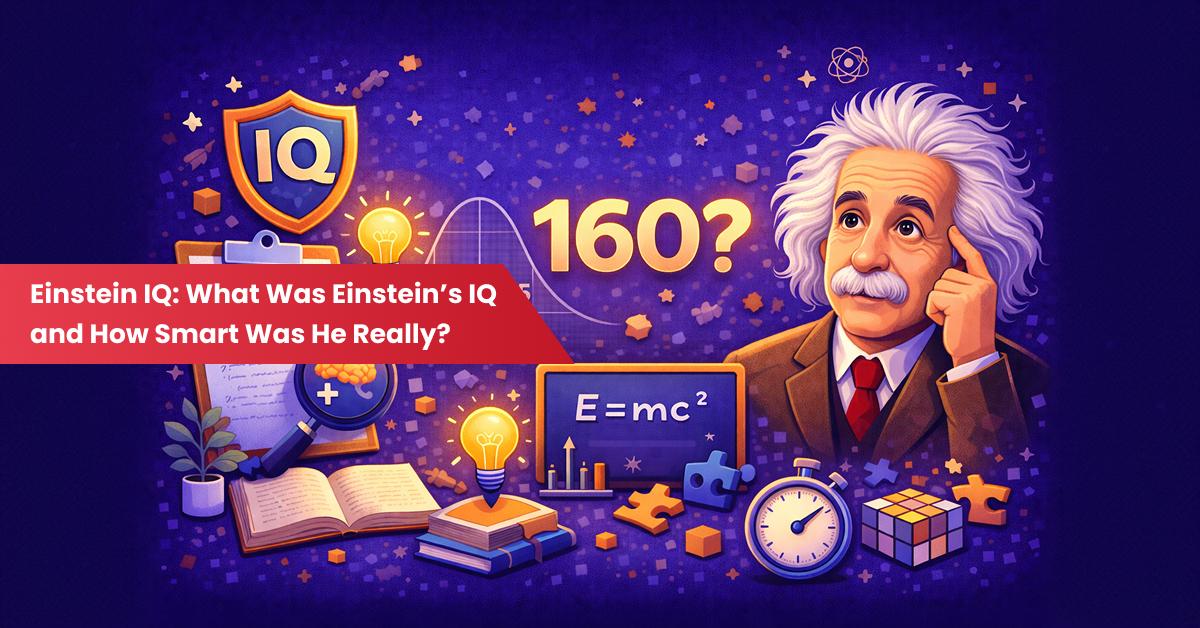
Albert Einstein remains one of the most recognizable names in the history of science. His theories changed the way humanity understands space, time, gravity, light, and energy. He is also frequently described as one of the most intelligent people who ever lived. That reputation has led to a question that continues to appear online: what is Einstein's IQ?
The answer is not as straightforward as many websites suggest. Einstein's exact IQ is unknown because there is no reliable evidence that he ever completed a standardized IQ test that produced a documented score. The number most commonly associated with him is 160, although some sources claim higher figures. These numbers are estimates rather than verified test results.
So, what is Einstein's IQ, and does knowing the number actually tell us how intelligent he was? Looking at the evidence reveals why his intellectual legacy cannot be reduced to a single score.
What Is Einstein's IQ?
There is no confirmed IQ score for Albert Einstein.
The frequently repeated figure of 160 is generally presented as an estimate based on his extraordinary intellectual achievements. Some sources have suggested scores of 160, 170, or even higher. However, none of these figures can be traced to a publicly documented IQ test taken by Einstein.
This distinction is important. An IQ score is normally produced through a standardized assessment administered under specific conditions. A person's performance is then compared with that of a relevant population. Einstein's supposed IQ was not obtained this way.
As a result, saying that Einstein "had an IQ of 160" as a confirmed fact is misleading. A more accurate statement is that Einstein's IQ has sometimes been estimated at around 160, but his actual score is unknown.
Why Do People Say Einstein Had an IQ of 160?
The number 160 has become closely connected with Einstein in popular culture. It appears in articles, social media posts, trivia pages, and discussions about famous geniuses.
The reason is easy to understand. Einstein made discoveries that required extraordinary abstract reasoning and conceptual thinking. His accomplishments make it reasonable to believe that he would have performed exceptionally well on many measures of intellectual ability.
However, estimating someone's IQ after their death is fundamentally different from administering an IQ test.
Historical figures can be evaluated based on their achievements, writings, education, problem-solving abilities, and intellectual contributions. Those observations may suggest exceptional intelligence, but they cannot produce a scientifically verified IQ score.
Therefore, the number 160 should be treated as an approximation rather than a documented fact.
Did Einstein Ever Take an IQ Test?
There is no reliable record showing that Einstein took a modern standardized IQ test.
Einstein was born in 1879, while intelligence testing was still developing. Alfred Binet and Théodore Simon created an influential early intelligence test in the early 1900s, and later psychologists developed other systems for measuring intellectual ability.
Modern IQ testing evolved significantly throughout the 20th century. Einstein's most famous scientific work, including special relativity, was already established before many modern approaches to intelligence testing became widespread.
This historical context helps explain why there is no official Einstein IQ score comparable to the scores people receive from standardized tests today.
Einstein's Intelligence Was Demonstrated Through His Work
Although we cannot provide a verified number, there is abundant evidence that Einstein possessed remarkable intellectual abilities.
In 1905, often called Einstein's "miracle year," he published several groundbreaking papers. His work addressed the photoelectric effect, Brownian motion, special relativity, and the relationship between mass and energy.
His 1905 paper on special relativity challenged established ideas about space and time. Einstein later developed general relativity, which provided a revolutionary explanation of gravity.
These achievements required exceptional mathematical reasoning, conceptual understanding, creativity, and persistence.
His intellectual accomplishments are therefore much stronger evidence of his abilities than an unverified IQ estimate.
Einstein Was More Than a Mathematical Genius
Popular culture sometimes portrays Einstein as someone who simply possessed an extraordinarily powerful mathematical brain. The reality was more nuanced.
Einstein was especially skilled at conceptualizing physical problems. He frequently used thought experiments to explore ideas that could not easily be tested in a laboratory.
For example, he imagined what would happen if an observer traveled alongside a beam of light. Thought experiments like these helped him challenge assumptions about motion, light, and time.
This ability to imagine physical situations from unusual perspectives was an important part of his scientific method.
Einstein's success demonstrates that creativity and imagination can be just as important as calculation when solving complex problems.
What Does an IQ Score Actually Measure?
To understand why Einstein's IQ may not matter as much as people think, it helps to understand what IQ tests measure.
Modern intelligence tests can assess several cognitive abilities, depending on the particular test. These may include logical reasoning, verbal comprehension, working memory, processing speed, and visual-spatial reasoning.
IQ scores can provide useful information about certain aspects of cognitive performance. They are not meaningless. However, an IQ score is not a complete measurement of human intelligence.
It does not directly capture qualities such as curiosity, creativity, motivation, persistence, emotional understanding, originality, or scientific imagination.
This distinction becomes especially important when discussing someone like Einstein.
Does a High IQ Guarantee Genius?
No.
A high IQ can indicate strong performance on particular cognitive tasks, but it does not guarantee that someone will make revolutionary discoveries.
Scientific achievement depends on many factors. A researcher needs knowledge, creativity, perseverance, curiosity, communication skills, and the opportunity to pursue important questions.
Einstein's career illustrates this point. His achievements were not simply the result of having a powerful memory or solving difficult puzzles quickly. He questioned assumptions that other scientists had accepted and developed entirely new conceptual frameworks.
This kind of creativity is difficult to summarize with one numerical score.
Einstein and the Importance of Curiosity
One of the most valuable aspects of Einstein's legacy is his approach to questions.
He was deeply curious about fundamental problems. Instead of simply accepting existing explanations, he asked whether the underlying assumptions were correct.
This approach contributed to his breakthroughs in physics.
Curiosity encouraged Einstein to investigate questions that others might have considered obvious. His work reminds us that intelligence is not only about knowing answers. It is also about asking better questions.
Someone can possess impressive knowledge but fail to make discoveries if they never challenge conventional thinking.
What About Einstein's School Performance?
Another popular story about Einstein claims that he failed mathematics in school. This has often been used as evidence that traditional grades cannot measure intelligence.
The story is largely based on misunderstandings involving grading systems and Einstein's educational history.
Einstein actually demonstrated strong mathematical abilities at an early age. He was not a student who simply struggled with mathematics and unexpectedly became a genius later in life.
However, he did have a complicated relationship with formal education. He disliked rigid educational environments and valued independent thinking.
His experience does offer a useful lesson: school performance and intelligence are related in complicated ways, and neither should be treated as a complete definition of a person's intellectual potential.
How Rare Would an IQ of 160 Be?
On a common IQ scale, the average score is 100, with a standard deviation of 15. A score of 160 would therefore be approximately four standard deviations above the average.
That would represent an exceptionally rare level of performance.
Yet extremely high IQ scores can be difficult to interpret. Tests have limits, scoring systems differ, and measurements become less precise at the extreme upper end.
This is another reason why claims that Einstein had an exact IQ of 160 or higher should be approached cautiously.
Why Are People So Interested in Einstein's IQ?
The fascination with Einstein's IQ reflects our desire to quantify extraordinary ability.
A number seems simple. It gives people a way to compare famous individuals and imagine where they might rank intellectually.
But comparing historical geniuses through IQ estimates can create a misleading picture. We cannot reliably determine whether Einstein was "smarter" than every other famous scientist simply by assigning him a number.
Scientific greatness is not a competition based on IQ points.
Different thinkers have different strengths. Some excel at mathematics, others at language, experimentation, creativity, leadership, or practical problem-solving.
Einstein's historical importance comes from what he accomplished, not from an estimated score.
So, What Is Einstein's IQ According to the Evidence?
If you are looking for a single number, the commonly cited answer is 160. However, the what is einstein's iq evidence does not support presenting 160 as Einstein's confirmed IQ.
The scientifically responsible answer is that Einstein's actual IQ is unknown.
The estimate of 160 may be plausible given his extraordinary intellectual achievements, but there is no authenticated test result that proves it.
This distinction is worth remembering whenever you encounter claims about the IQs of historical figures.
Does Einstein's IQ Really Matter?
Ultimately, probably not.
Knowing Einstein's exact IQ would satisfy curiosity, but it would add little to our understanding of why his work was so important.
His legacy rests on his ideas. He transformed physics by challenging fundamental assumptions and creating theories that continue to influence scientific research more than a century later.
The more meaningful question is not simply "How high was Einstein's IQ?" It is "How did Einstein think?"
His life highlights the value of curiosity, imagination, independent reasoning, persistence, and the courage to question established ideas.
Those qualities are useful far beyond physics.
Final Thoughts
So, what is Einstein's IQ? The honest answer is that nobody knows his exact score. The figure of 160 is a popular estimate, not a verified result from a standardized IQ test.
Einstein was unquestionably an extraordinary thinker. His theories reshaped modern physics and demonstrated an exceptional combination of abstract reasoning, imagination, mathematical understanding, and intellectual persistence.
His story also shows why intelligence cannot be completely represented by a number. An IQ score can measure certain cognitive abilities, but it cannot fully capture creativity, curiosity, originality, or the ability to change an entire field of knowledge.
In the end, Einstein's greatest achievement was not having a supposedly enormous IQ. It was what he did with his mind. His willingness to question assumptions and explore ideas that seemed impossible helped produce some of the most influential scientific theories in history.
That is far more meaningful than any number.

 Arabic
 French
 Spanish
 Portuguese
 Deutsch
 Turkish
 Dutch
Dutch
 Italiano
 Russian
 Romaian
 Portuguese (Brazil)
 Greek
Greek
