


 About Urh Social
 Terms of Service
 Privacy Policy
 Contact
How Can Students Paraphrase Academic Sources Without Losing the Original Meaning?
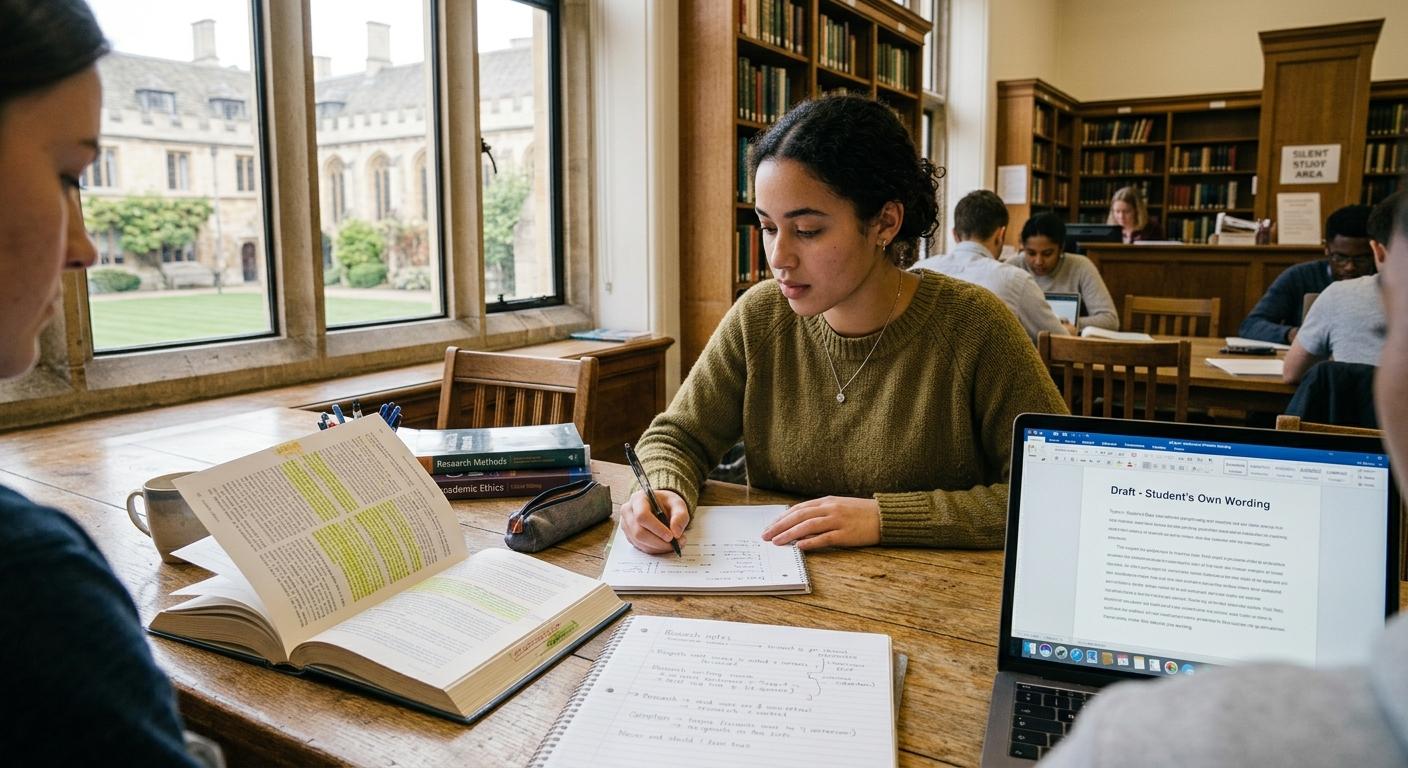
Paraphrasing an academic source means expressing another author's ideas in your own words while preserving the source's original meaning, accuracy, and context. To understand how to paraphrase academic sources , students need to do more than replace individual words with synonyms. Effective paraphrasing requires understanding the source first, identifying its central idea, changing the sentence structure, and giving proper credit to the original author. This approach helps students use evidence responsibly without distorting an academic argument or unintentionally copying the source.
Paraphrasing is especially useful when a source contains an idea that supports your argument but does not need to be quoted word for word. The challenge is finding the right balance: the wording should be genuinely your own, but the underlying idea must remain faithful to the original.
In This Guide You'll Learn
-
What makes an academic paraphrase accurate and genuinely original
-
A practical process for paraphrasing scholarly material without changing its meaning
-
Common paraphrasing mistakes that can lead to distortion or plagiarism
-
How to review and improve a paraphrase before using it in academic writing
What Does Effective Academic Paraphrasing Mean?
A strong paraphrase communicates the same essential idea as the source while using substantially different wording and sentence construction. It does not simply substitute synonyms for selected words.
Consider a source that explains that regular feedback can help students identify weaknesses in their understanding and adjust their learning strategies. A weak paraphrase might replace words such as "identify" with "recognize" and "adjust" with "change" while keeping nearly the same sentence structure.
That is not meaningful paraphrasing. The language remains too close to the original.
A better approach is to understand the author's point first and then reconstruct it from your own understanding. For example:
Source idea: Frequent feedback helps learners recognize gaps in their knowledge and modify how they study.
Effective paraphrase: Regular responses from instructors can show students where their understanding is incomplete and help them adapt their approach to learning.
The second version changes the structure and wording while preserving the central relationship between feedback, understanding, and learning strategies.
Paraphrasing Is More Than Replacing Words
A useful paraphrase usually involves several changes:
-
Vocabulary is expressed naturally in your own language.
-
Sentence structure is reorganized.
-
The order in which ideas are presented may change.
-
Complex ideas are restored according to your understanding.
-
The original meaning and important qualifications are preserved.
-
The source is still acknowledged through an appropriate citation.
The goal is not to make the source sound different merely for the sake of being different. The goal is to communicate the author's idea accurately through your own expression.
Actionable Takeaway: Before changing any words, ask yourself, "What is this author actually saying?" If you cannot explain the idea without looking at the source, you are probably not ready to paraphrase it.
Why Is Preserving the Original Meaning So Important?
Academic sources often contain carefully qualified claims. Changing a small word or removing a condition can make the author's argument appear stronger, weaker, broader, or more certain than it actually is.
For example, suppose a researcher writes that a particular teaching method "may improve student engagement under certain classroom conditions." A paraphrase stating that the method "improves student engagement" changes the level of certainty and removes an important limitation.
That creates a problem even if none of the original wording was copied.
Students therefore need to preserve:
-
The central claim
-
The author's intended meaning
-
Important qualifications
-
Relationships between ideas
-
Cause-and-effect relationships when stated
-
Relevant limitations
-
The strength or degree of certainty expressed by the author
This is particularly important when paraphrasing research findings, theoretical arguments, definitions, or evidence-based claims.
Read for Meaning Before Reading for Wording
One effective technique is to read the source carefully and then look away from it.
Ask:
-
What is the main point?
-
What evidence or reasoning supports that point?
-
Are there important limitations or conditions?
-
What terms are essential to the meaning?
-
How would I explain this idea to another student?
Your answers become the foundation for the paraphrase.
Actionable Takeaway: Focus on the author's idea rather than the author's sentence. Meaning should guide your writing; the original wording should not.
How to Paraphrase Academic Sources Step by Step
Learning how to paraphrase academic sources becomes easier when the process is treated as a sequence rather than a word-by-word editing exercise.
1. Read the Entire Relevant Passage
Do not immediately start rewriting the first sentence you see. Read enough of the surrounding material to understand the context.
A single sentence may depend on information presented before or after it. Without that context, you may accidentally misrepresent what the author intended.
2. Identify the Main Idea
Determine what the passage contributes to the discussion.
You might write a short private note such as:
"The author argues that early feedback helps students recognize misconceptions before they become established."
This note should capture the meaning without copying the source's wording.
3. Set the Source Aside
Once you understand the passage, temporarily stop looking at the original.
This encourages you to reconstruct the idea from your understanding rather than unconsciously following the source's sentence pattern.
4. Write the Idea in Your Own Structure
Build a new sentence or group of sentences from your notes.
You may change the grammatical structure, combine related ideas, or reorganize the order in which information appears.
For example, an original sentence may begin with a cause and end with an effect. Your version could begin with the effect and then explain the contributing factor, provided the meaning remains accurate.
5. Compare Your Version With the Source
Now return to the original and compare the two.
Check whether:
-
You accidentally copied distinctive phrases.
-
Your sentence structure remains too similar.
-
You changed the meaning.
-
You removed an important qualification.
-
You introduced an idea that the author did not make.
-
You changed the author's level of certainty.
6. Add the Appropriate Citation
Paraphrasing does not make someone else's idea your own. Even though the wording is original, the underlying information or argument still comes from the source.
Therefore, follow the citation requirements specified by your instructor or institution.
7. Check the Paragraph as a Whole
Finally, make sure the paraphrase actually supports your own discussion.
A source should have a purpose in your writing. Explain why the evidence matters instead of placing a paraphrased passage into a paragraph without connecting it to your argument.
A Practical Before-and-After Example
The difference between weak and effective paraphrasing becomes clearer when the approaches are compared.
|
Approach |
What Happens |
Why It Matters |
|
Original source |
Author presents the original idea and wording |
Establishes the source's contribution |
|
Word substitution |
Student changes several words but keeps the structure |
May remain too close to the source |
|
Unfaithful paraphrase |
Student changes wording but alters the claim |
Misrepresents the author's meaning |
|
Effective paraphrase |
Student understands the idea, reconstructs it, preserves meaning, and cites the source |
Communicates evidence accurately and responsibly |
Imagine that a source states:
"Students who receive timely feedback can identify misunderstandings earlier and make adjustments to their learning strategies."
A weak version could be:
"Students who get prompt feedback can recognize misunderstandings sooner and make changes to their learning strategies."
Although several words have changed, the structure is almost identical.
A stronger version might be:
"Prompt instructor responses can help learners recognize gaps in their understanding before those misconceptions become more established, allowing them to modify how they approach the material."
The second version reorganizes the idea while retaining its essential meaning.
Common Mistakes That Weaken Academic Paraphrases
Even students who understand the basic concept can make mistakes during the rewriting process.
Changing Only a Few Words
This is one of the most common problems. Opening a thesaurus and replacing individual words does not automatically produce an original paraphrase.
Some academic terms may also need to remain unchanged because they represent established concepts. The objective is not to eliminate every word that appears in the source.
Keeping the Original Sentence Pattern
A student may change vocabulary while preserving the same subject, verb, object, and clause arrangement.
When the structure remains nearly identical, the writing can still be too close to the source.
Changing the Meaning
A paraphrase can be linguistically original but academically inaccurate.
Be especially careful with words such as:
-
May
-
Might
-
Often
-
Generally
-
Some
-
Most
-
Always
-
Never
-
Associated with
-
Causes
These terms can significantly affect the strength or scope of a claim.
Leaving Out Important Qualifications
Academic authors frequently qualify their conclusions. Removing those qualifications can make a careful argument appear absolute.
If the source says that a finding applies "under specific conditions," that condition should not disappear simply because it makes your sentence longer.
Forgetting the Citation
A paraphrase still represents another person's intellectual contribution. Changing the wording does not remove the need to acknowledge the source.
Over-Paraphrasing
Not every sentence needs to be paraphrased. Some definitions, technical expressions, or particularly precise statements may be better handled as direct quotations when your assignment permits them.
The important consideration is why you are using the source and which presentation method communicates the evidence most effectively.
Actionable Takeaway: After paraphrasing, compare both meaning and structure. A good paraphrase should be independently written without becoming independently interpreted.
How Can Students Make Paraphrasing More Accurate?
Accuracy improves when students separate understanding from writing.
One useful method is the read–note–rewrite–compare process:
Read: Understand the passage and its context.
Note: Record the central idea in brief language rather than copying sentences.
Rewrite: Create a new explanation using your own sentence structure.
Compare: Check your version against the source for accuracy, similarity, and missing qualifications.
You can also ask yourself three final questions:
-
Could I explain this idea without looking at the source?
-
Does my version preserve what the author actually claimed?
-
Have I clearly acknowledged where the idea came from?
If the answer to all three is yes, the paraphrase is much more likely to be both useful and academically responsible.
Be Careful With Technical Terms
Some terminology cannot easily be replaced without changing the meaning. For example, a specific scientific, legal, psychological, or theoretical term may have a precise definition.
Do not replace technical terminology simply to make your writing look different. Instead, restructure the surrounding explanation while retaining necessary terminology accurately.
This distinction is important: original wording does not mean inventing new terminology or altering established concepts.
A Realistic Student Example
Consider a student named Maya who is writing a research-based assignment about online learning. She finds a scholarly source explaining that students can benefit from flexible learning environments, but that flexibility may also require stronger self-management.
Maya initially rewrites the sentence by replacing several words with synonyms. When she compares her draft with the source, she notices that the sentence structure is nearly identical.
She starts again. This time, she writes down the central idea: flexibility can help learners, but students need to manage their time and learning independently.
She then develops a new sentence from that note and checks it against the source. Her final version preserves both sides of the author's argument rather than presenting flexibility as universally beneficial.
The important lesson is that Maya did not begin with synonyms. She began with understanding.
How to Check a Paraphrase Before Submitting Your Work
A final review can prevent many avoidable problems.
Meaning Check
Ask whether your version communicates the same central idea as the original. Pay particular attention to qualifications, comparisons, conditions, and conclusions.
Similarity Check
Look for distinctive phrases and sentence patterns that remain unnecessarily close to the source. Some common academic terms may naturally overlap, but copied phrasing should be reconsidered.
Citation Check
Confirm that the source has been acknowledged according to the required academic style or institutional guidelines.
Context Check
Read the paragraph surrounding the paraphrase. Make sure the source's idea actually supports your argument and that you have not accidentally presented the author's position as your own.
Accuracy Check
Compare names, concepts, dates, findings, and other details against the source. Paraphrasing should not introduce factual errors.
Actionable Takeaway: Treat paraphrasing as a two-part task: first understand the source, then communicate that understanding accurately in your own language.
Frequently Asked Questions
1. Is paraphrasing academic sources the same as summarizing them?
No. A paraphrase usually restates a specific idea or passage at roughly a similar level of detail, while a summary condenses the main points of a larger section or source. Both should accurately represent the original and acknowledge the source when required.
2. How can I avoid changing the author's meaning when paraphrasing?
First identify the author's main claim, supporting reasoning, and important qualifications. Write from your notes rather than copying the source sentence. Then compare your version with the original to check whether you accidentally strengthened, weakened, or altered the argument.
3. Do I need to cite a paraphrased academic source?
Yes. Paraphrasing changes the wording, not the ownership of the underlying idea. Follow the citation requirements established by your instructor, institution, or required academic style.
4. Is changing every word enough to create a good paraphrase?
No. Replacing words with synonyms while preserving the original sentence structure can still produce an overly similar version. Effective paraphrasing involves understanding the idea and reconstructing it using your own wording and sentence structure.
5. How to paraphrase academic sources without losing important details?
Read the passage carefully, identify its central meaning and qualifications, set the original aside, write from your understanding, and then compare your version with the source. Pay particular attention to words that indicate certainty, limitations, conditions, or scope.
Conclusion
Students can paraphrase academic sources effectively without losing the original meaning by treating paraphrasing as an exercise in understanding rather than word replacement. Read the source in context, identify its central claim, take brief notes, reconstruct the idea in your own sentence structure, and then compare your version with the original for accuracy. Most importantly, preserve the author's intended meaning and acknowledge the source appropriately. Learning how to paraphrase academic sources this way allows students to incorporate scholarly evidence while maintaining clear, original, and academically responsible writing.

 English
 Arabic
 French
 Spanish
 Portuguese
 Deutsch
 Dutch
Dutch
 Italiano
 Russian
 Romaian
 Portuguese (Brazil)
 Greek
Greek
