


 About Urh Social
 Terms of Service
 Privacy Policy
 Contact
BIS FMCS Certification in Nepal: Complete Guide for Indian Market Entry
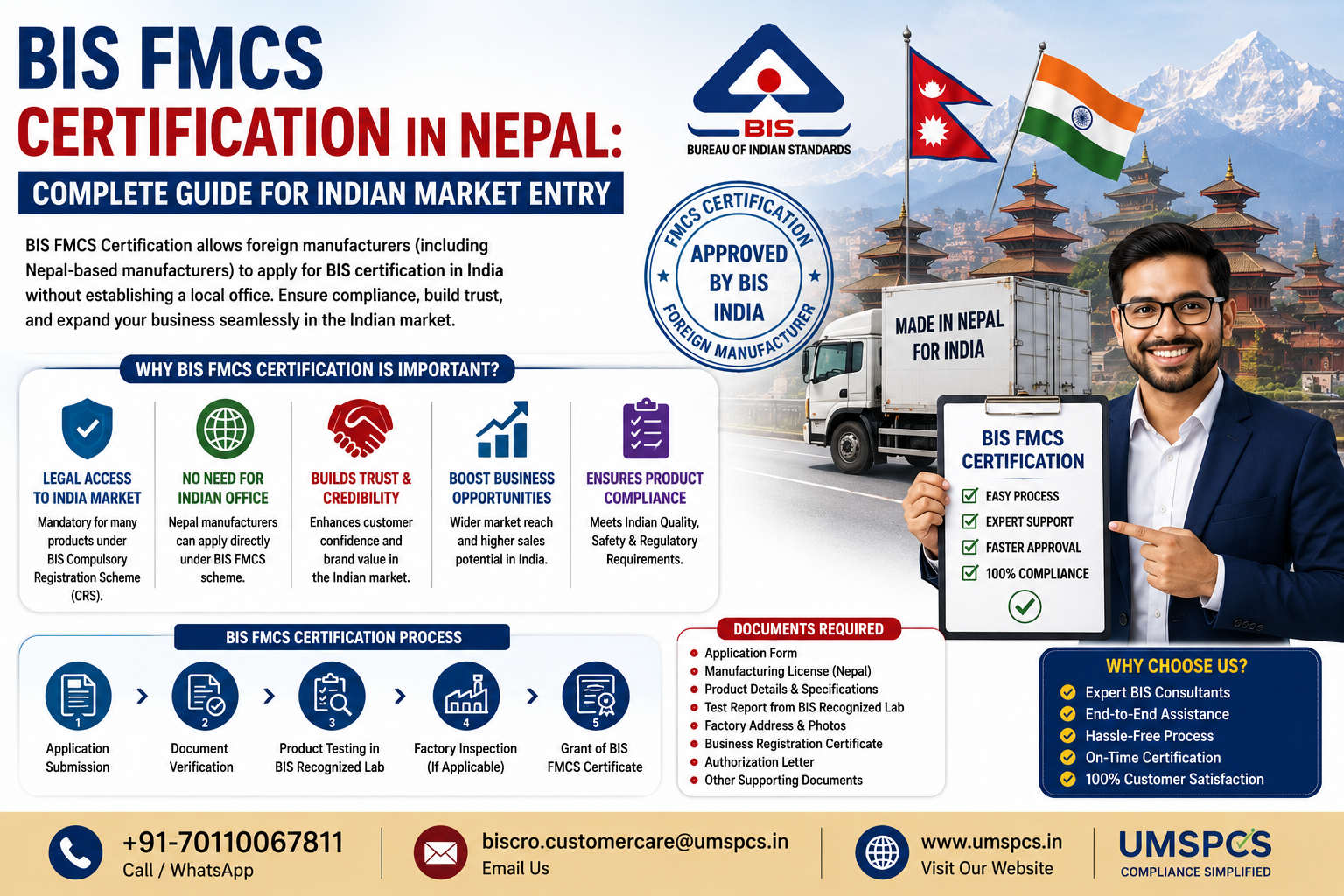
If you manufacture steel, cement, or other construction-grade products in Nepal and want to sell in India, there's one approval you cannot skip: BIS FMCS Certification in Nepal. The Bureau of Indian Standards (BIS) requires foreign manufacturers, including those based in Nepal, to obtain this certification under the Foreign Manufacturers Certification Scheme before their goods can legally enter the Indian market.
For Nepali exporters, this isn't just paperwork. It's the difference between a shipment that clears customs smoothly and one that gets stuck, rejected, or fined at the border. In this guide, we'll walk through what BIS FMCS Certification in Nepal actually involves, why it exists, who needs it, and how a consulting partner like UMSPCS can simplify the entire journey.
What Is BIS FMCS Certification?
FMCS stands for Foreign Manufacturers Certification Scheme, a program run by the Bureau of Indian Standards to regulate products manufactured outside India but sold within the country. Unlike the domestic BIS license (which applies to Indian factories), FMCS is specifically designed for overseas manufacturing units, including those located in Nepal.
Once granted, this certification confirms that a product meets India's mandatory quality and safety standards. Without it, customs authorities can legally block the shipment, and retailers in India cannot stock the product. That's why understanding BIS FMCS Certification in Nepal is essential for any business owner planning cross-border trade with India.
Why Nepal-Based Manufacturers Need This Certification
India is Nepal's largest trading partner, and many product categories, particularly steel bars, cement, electrical items, and certain chemicals, fall under India's mandatory BIS certification list. If a Nepali factory wants to export these goods to Indian buyers, skipping this step simply isn't an option.
Here's why it matters practically:
-
Legal market access: Indian customs will not clear consignments of regulated products without valid BIS approval.
-
Buyer trust: Indian importers and distributors prefer certified suppliers because it reduces their own compliance risk.
-
Competitive edge: Certified Nepali manufacturers can bid for larger contracts, government tenders, and long-term supply agreements in India.
-
Avoiding penalties: Non-compliant shipments can be seized, returned, or destroyed, causing heavy financial loss.
Given these stakes, applying early for BIS FMCS Certification in Nepal saves manufacturers from costly delays down the line.
Which Products Require FMCS Certification?
Not every product needs this approval, but a significant number of industrial and consumer goods do. Common categories include:
-
Steel and steel products (TMT bars, structural steel)
-
Cement
-
Electrical appliances and cables
-
Toys
-
Certain chemicals and industrial equipment
-
Cylinders, valves, and pressure equipment
If you're unsure whether your product falls under India's mandatory certification list, it's worth checking with a compliance consultant before you invest time in production or shipping.
Read more about BIS ISI certification in Indonesia .
Step-by-Step Process for BIS FMCS Certification in Nepal
The certification journey typically follows these stages:
1. Product Assessment
The manufacturer's product is evaluated against the relevant Indian Standard (IS) to confirm which quality parameters apply.
2. Application Submission
An application is filed with BIS through their official online portal, along with company details, product specifications, and manufacturing information.
3. Factory Inspection
BIS-appointed auditors visit the Nepal-based manufacturing facility to inspect production processes, quality control systems, and testing infrastructure. This step confirms the factory can consistently produce goods meeting Indian standards.
4. Sample Testing
Product samples are tested in a BIS-recognized laboratory. Results must meet the specified Indian Standard for the certificate to move forward.
5. Certificate Grant
Once inspection and testing are successfully completed, BIS issues the FMCS license, permitting the manufacturer to use the ISI mark (where applicable) and export to India.
6. Renewal and Surveillance
The certificate isn't a one-time approval. Periodic surveillance audits and renewals are required to maintain validity.
Documents Typically Required
While exact requirements vary by product category, manufacturers usually need:
-
Company registration and business license from Nepal
-
Factory layout and manufacturing process details
-
Quality control manual
-
Test reports from accredited labs (if available)
-
Details of raw material sourcing
-
Authorized representative information in India
Having these documents organized in advance significantly speeds up the BIS FMCS Certification in Nepal process.
Read more about BIS CRS Process .
Common Challenges Nepali Manufacturers Face
Many businesses underestimate the complexity of this certification and run into avoidable roadblocks:
-
Language and documentation gaps: BIS forms and standards are detailed, and errors can cause rejection or delay.
-
Factory readiness: Some units aren't fully prepared for BIS-style audits and need process upgrades first.
-
Long timelines: Without proper guidance, the process can stretch far longer than necessary.
-
Communication with BIS officials: Coordinating inspection schedules and clarifications from Nepal adds another layer of difficulty.
This is exactly where working with an experienced consultancy makes a measurable difference.
How UMSPCS Helps
UMSPCS specializes in guiding manufacturers through complex regulatory approvals, including BIS FMCS Certification in Nepal. Instead of navigating the scheme alone, businesses working with UMSPCS get support across the full lifecycle:
-
Initial product and standard applicability assessment
-
Documentation preparation and application filing
-
Factory audit readiness support
-
Coordination with testing laboratories
-
Liaison with BIS officials throughout inspection and approval
-
Renewal and ongoing compliance assistance
The goal is simple: reduce delays, avoid rejections, and get Nepali manufacturers into the Indian market with confidence.
Final Thoughts
Entering the Indian market from Nepal comes with real opportunity, but only if your products meet India's regulatory requirements. BIS FMCS Certification is a mandatory step for many product categories, and treating it as a priority rather than an afterthought can save significant time, money, and stress. With the right guidance from a team like UMSPCS, manufacturers can move through inspection, testing, and approval smoothly and start shipping to India with full legal compliance.
Frequently Asked Questions (FAQs)
Q1. What is BIS FMCS Certification, and who needs it?
BIS FMCS Certification is a mandatory approval from India's Bureau of Indian Standards for foreign manufacturers, including those in Nepal, who want to export regulated products like steel, cement, or electrical goods to India.
Q2. How long does it take to get BIS FMCS Certification in Nepal?
Timelines vary depending on the product category and factory readiness, but the process generally involves application review, factory inspection, and sample testing, which can take several months from start to finish.
Q3. Is factory inspection compulsory for this certification?
Yes. BIS-appointed auditors physically inspect the manufacturing unit in Nepal to verify quality control systems and production processes before certification is granted.
Q4. Can UMSPCS help with product categories beyond steel and cement?
Yes. UMSPCS assists with a wide range of products under the FMCS scheme, including electrical items, cylinders, chemicals, and more, depending on applicability.
Q5. What happens if a Nepali exporter ships to India without this certification?
Shipments of regulated products without valid BIS approval can be held at customs, rejected, or returned, resulting in significant financial and reputational loss for the exporter.
Q6. Does the certificate need to be renewed?
Yes. BIS FMCS Certification requires periodic renewal and ongoing surveillance audits to remain valid, ensuring continued compliance with Indian standards.

 English
 Arabic
 French
 Spanish
 Portuguese
 Deutsch
 Turkish
 Dutch
Dutch
 Italiano
 Russian
 Portuguese (Brazil)
 Greek
Greek
