


 About Urh Social
 Terms of Service
 Política de privacidade
 Contact
How Procurement Teams Can Build a Reliable Organic Ginger Sourcing Program
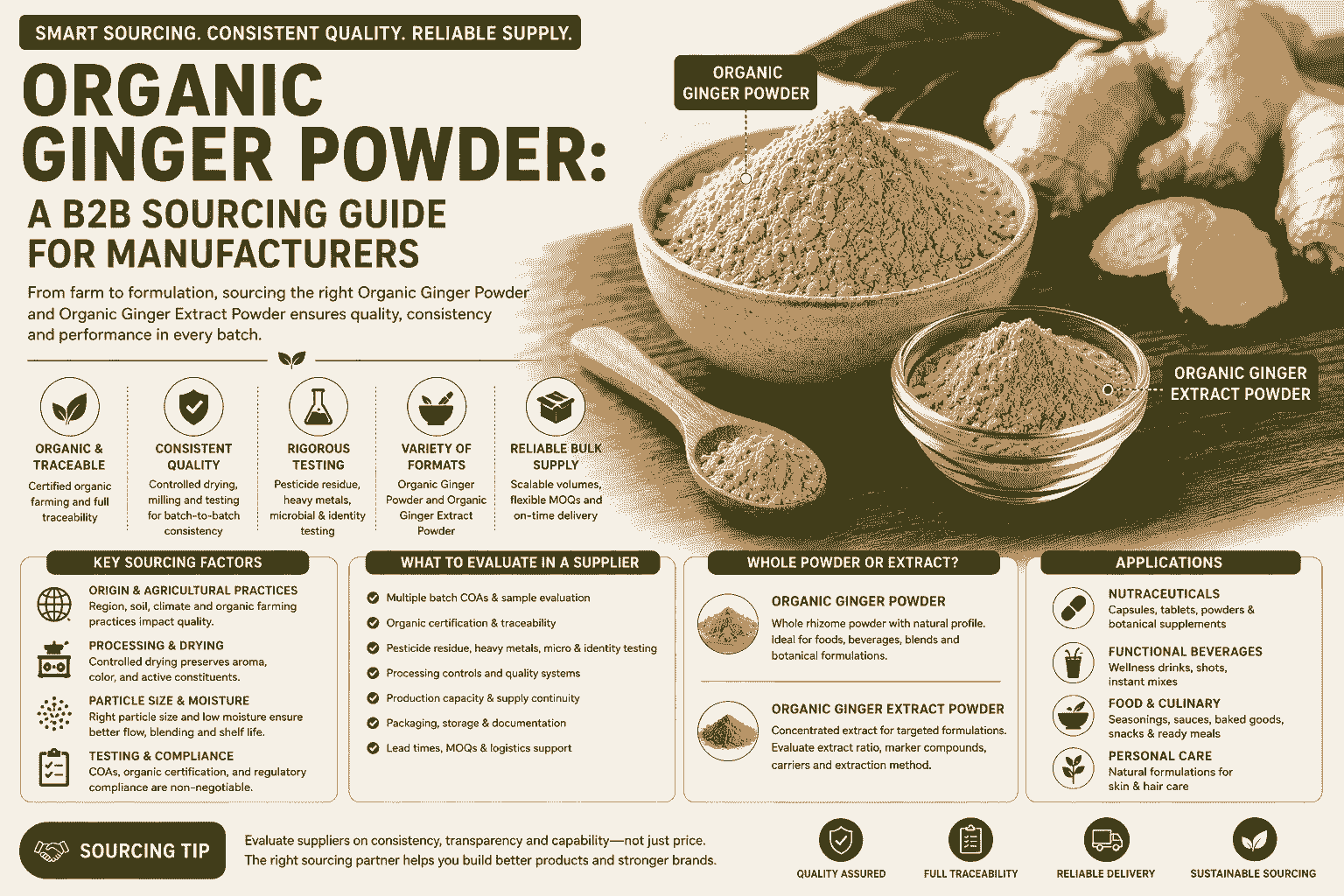
A supplier can deliver a good ginger sample and still fail to provide the consistency required for commercial manufacturing. This is one of the practical challenges procurement teams face when sourcing botanical ingredients. The issue is rarely limited to whether the ingredient meets a specification. It is about whether the supplier can reproduce that specification across different batches, maintain supply, and provide an ingredient that works within the intended formulation.
For manufacturers evaluating Organic Ginger Powder and Organic Ginger Extract Powder, a structured supplier-evaluation process can reduce these risks. Instead of treating procurement as a quotation exercise, sourcing teams can assess the ingredient through several connected checkpoints.
1. Define the Raw Material Before Comparing Suppliers
The first step is to establish exactly what the manufacturing team needs.
Organic Ginger Powder is made by drying and milling ginger rhizomes, generally from Zingiber officinale. It is suitable for applications where a whole botanical powder is appropriate.
Organic Ginger Extract Powder follows a different processing route. Ginger is extracted and concentrated before being converted into a powder. Depending on the product, the specification may include an extract ratio, assay, marker compounds, or carrier information.
These differences matter when comparing supplier quotations. A kilogram of whole powder cannot be directly compared with a kilogram of concentrated extract without considering inclusion rate and formulation requirements.
2. Score the Agricultural Source
Ginger is an agricultural raw material, so natural variation begins at the farm level. India, China, Peru, and other producing regions contribute to the global supply, and each origin can have different cultivation and post-harvest practices.
Procurement teams should document:
- Botanical identity
- Country and region of origin
- Organic certification
- Cultivation controls
- Harvest information
- Agricultural traceability
- Pesticide-residue controls
Origin should not be used as a simple indicator of quality. Instead, it should help buyers understand the supply chain behind the ingredient and identify potential risks related to crop variability or availability.
3. Evaluate Processing, Not Just the Final Powder
Two suppliers can start with comparable ginger but produce different commercial ingredients because of processing differences.
For Organic Ginger Powder, drying and milling deserve particular attention. Drying influences moisture, color, aroma, and storage characteristics. Milling determines particle size and can affect flowability and blending.
For Organic Ginger Extract Powder, the evaluation becomes more detailed. Buyers should understand:
- Extraction method
- Extract ratio
- Concentration process
- Marker or assay requirements
- Carrier materials
- Drying method
- Residual solvents where applicable
A clear understanding of processing allows R&D teams to better predict how the material may behave in production.
4. Create a Multi-Batch Qualification Process
One of the most useful sourcing practices is testing multiple production lots instead of approving a supplier based on one sample.
A single sample answers the question, “Can this supplier produce an acceptable batch?”
Multiple samples provide insight into a more important question: “Can the supplier reproduce the same quality consistently?”
Teams can compare:
- Color
- Aroma
- Moisture
- Particle size
- Bulk density
- Flowability
- Dispersion
- Blend uniformity
For beverage manufacturers, dispersion may be a major consideration. For dry supplement blends, particle distribution and flowability may receive more attention.
5. Build a Documentation Checklist
Quality documentation should be reviewed according to the final application.
For Organic Ginger Powder, buyers may request:
- Certificate of Analysis
- Organic certification
- Botanical identity testing
- Microbiological results
- Heavy metal testing
- Pesticide-residue analysis
- Moisture specification
- Particle-size information
- Allergen statement
- Country-of-origin documentation
For Organic Ginger Extract Powder, procurement teams may also need extraction details, extract ratio, assay or marker specifications, carrier information, and residual-solvent data where relevant.
The purpose of this documentation is to verify identity, consistency, safety, and suitability—not simply to complete a supplier checklist.
6. Test the Ingredient in the Actual Application
Laboratory testing should be followed by application testing wherever practical.
An Organic Ginger Powder that performs well in a small laboratory blend may behave differently in a high-volume ribbon blender. Similarly, an extract powder may show different dispersion characteristics when introduced into a commercial beverage system.
R&D teams should therefore evaluate the ingredient under realistic processing conditions before final supplier approval.
This step can identify issues related to dusting, mixing time, dispersion, clumping, sensory characteristics, or interaction with other raw materials.
7. Evaluate Supply Reliability Separately From Quality
A technically compliant supplier may still be unsuitable for long-term procurement if supply continuity is weak.
Before approving commercial volumes, sourcing teams should assess:
- Production capacity
- Minimum order quantities
- Typical lead times
- Finished inventory
- Packaging formats
- Storage conditions
- Seasonal supply risks
- Logistics capability
- Batch traceability
- Contingency planning
This becomes particularly important when ginger is a critical component of a high-volume product.
Turning Supplier Evaluation Into a Long-Term Strategy
A strong ginger sourcing program should connect procurement, quality, and formulation teams. Each department sees a different part of the risk.
Procurement evaluates price, capacity, and delivery. Quality verifies documentation and specifications. R&D determines whether the ingredient performs as required in the finished formulation.
When these evaluations are combined, supplier selection becomes more reliable.
For Organic Ginger Powder, attention should center on agricultural origin, drying, milling, physical consistency, testing, and supply continuity. For Organic Ginger Extract Powder, extraction parameters, concentration, assay, carriers, and cost-in-use become additional considerations.
Conclusion
Reliable sourcing is not achieved by finding one supplier with an attractive quotation. It comes from establishing clear specifications, understanding the production process, comparing multiple batches, conducting application trials, and assessing commercial supply capability.
For manufacturers purchasing Organic Ginger Powder or Organic Ginger Extract Powder, this structured approach can help identify potential problems before they reach the production line. More importantly, it gives procurement teams a practical framework for building a supply relationship based on repeatable quality, transparent information, and dependable commercial performance.

 English
 Arabic
 French
 Spanish
 Portuguese
 Deutsch
 Turkish
 Dutch
Dutch
 Italiano
 Russian
 Romaian
 Greek
Greek
