


 About Urh Social
 Terms of Service
 Privacy Policy
 Contact
SOC Services Companies in India: The Bold Shift Healthcare Can't Delay
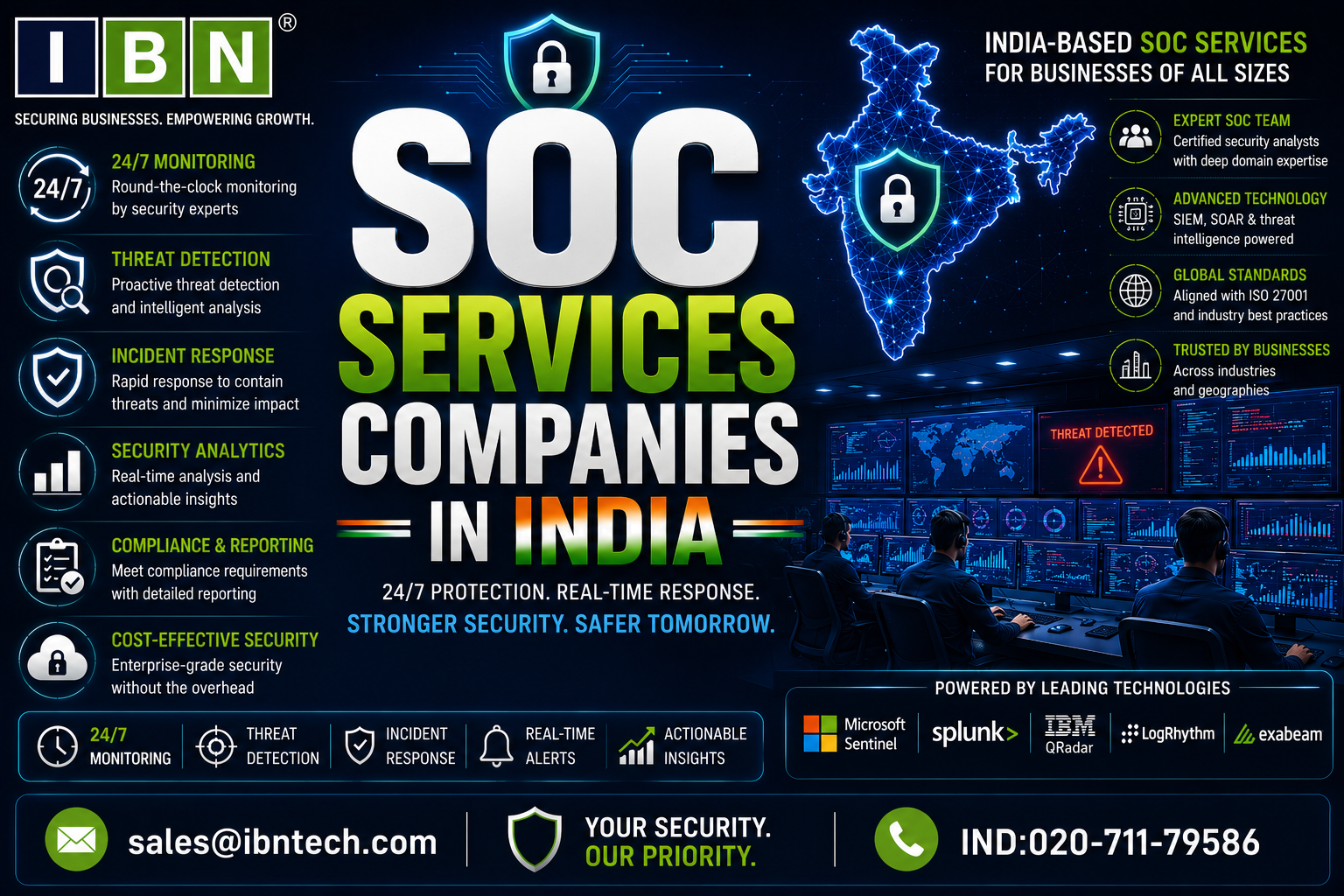
Where SOC Services Companies in India Are Headed Next for Healthcare
Five years ago, most hospital IT teams in India worried primarily about keeping systems running. Today, the conversation has shifted toward proving those systems are being actively watched for threats around the clock. That shift says a lot about where SOC services companies in India are headed, and why healthcare organizations should be paying close attention.
Why Healthcare's Security Needs Are Evolving Quickly
Hospitals and diagnostic networks are digitizing faster than ever, connecting medical devices, electronic health records, and third-party vendor systems into increasingly complex environments. Each new connected system expands the attack surface, and patient data, valuable for years after a breach, remains a consistent target. Healthcare security can no longer be treated as a secondary IT function bolted onto clinical operations.
The Driver Behind Changing Expectations
Regulatory attention to patient data protection is increasing, and patients themselves are more aware than ever of how their medical information is handled digitally. Healthcare providers are being asked, implicitly and explicitly, to prove that patient data is protected continuously, not just reviewed occasionally. This expectation is reshaping what healthcare organizations look for in a security partner.
Why Older Security Models No Longer Hold Up
Many healthcare organizations built their current security posture years ago, often around a small internal IT team checking systems during business hours. This approach is increasingly mismatched with today's risk environment:
- Connected medical devices introduce vulnerabilities that traditional network monitoring wasn't designed to catch
- After-hours and weekend gaps remain the most exploited window for attackers
- Small internal teams cannot realistically keep pace with evolving attack techniques targeting healthcare specifically
- Manual, periodic reviews miss the real-time correlation needed to catch multi-step intrusions early
The Future of SOC Services in India for Healthcare
The future of SOC services in India for healthcare is trending toward deeper integration with clinical systems, not just traditional IT infrastructure. This means monitoring that understands the specific risk patterns of connected medical devices, patient portals, and health information exchanges, rather than applying generic enterprise security models to a fundamentally different environment.
What This Shift Looks Like in Practice
IBN Technologies' Managed SIEM & SOC service reflects this direction by providing continuous monitoring and expert-led incident response designed to close the after-hours and weekend gaps that have historically been healthcare's biggest vulnerability, giving hospital IT teams coverage that keeps pace with how connected their environments have become.
Emerging Priorities for Healthcare Security Buyers
- Continuous monitoring that extends to connected medical devices, not just servers and endpoints
- Faster detection of ransomware, which remains a persistent threat to hospital operations
- Documentation and reporting that supports growing patient data protection expectations
- Scalability as healthcare networks expand across multiple facilities and digital channels
Healthcare Security Then and Now
|
Aspect |
Traditional Approach |
Where Healthcare Security Is Heading |
|
Monitoring scope |
IT servers and endpoints only |
Includes connected medical devices |
|
Coverage hours |
Business hours |
Continuous, 24/7 |
|
Response model |
Reactive, internal-only |
Expert-led, structured response |
|
Documentation |
Informal |
Continuous, audit-ready |
Industry Use Case: Expanding Hospital Networks
A hospital network adding new facilities and telemedicine services faces a rapidly growing attack surface, often faster than its internal IT team can adapt to monitor. Partnering with a SOC provider built around this evolving healthcare risk profile allows the network to expand digital services confidently, without security oversight lagging behind growth.
Benefits for Healthcare Organizations Adapting Early
Healthcare providers that move toward continuous, healthcare-aware monitoring now, rather than waiting for an incident to force the decision, gain reduced pressure on stretched internal IT staff, faster response to ransomware and unauthorized access attempts, and a stronger position to reassure patients and partners about data protection.
Best Practices for Healthcare Leaders Planning Ahead
- Assess whether your current security setup accounts for connected medical devices
- Ask potential providers directly about their experience with healthcare-specific systems
- Prioritize continuous monitoring over periodic review models going forward
- Revisit your security posture as new facilities, devices, or digital services are added
Compliance Context for Healthcare Providers
As patient data protection expectations continue to tighten across India, healthcare organizations that adopt forward-looking, continuous monitoring now will find compliance conversations far less stressful later. Working with established SOC services companies in India that understand where healthcare security is heading helps hospitals stay ahead of expectations rather than catching up to them after an incident.
The direction is clear: healthcare security is moving from periodic and reactive toward continuous and integrated, and the organizations that adapt early will be far better positioned than those that wait.

 English
 Arabic
 French
 Spanish
 Portuguese
 Deutsch
 Turkish
 Italiano
 Russian
 Romaian
 Portuguese (Brazil)
 Greek
Greek
