


 About Urh Social
 Terms of Service
 Privacy Policy
 Contact
Ship Repair vs. Ship Maintenance: Understanding the Key Differences
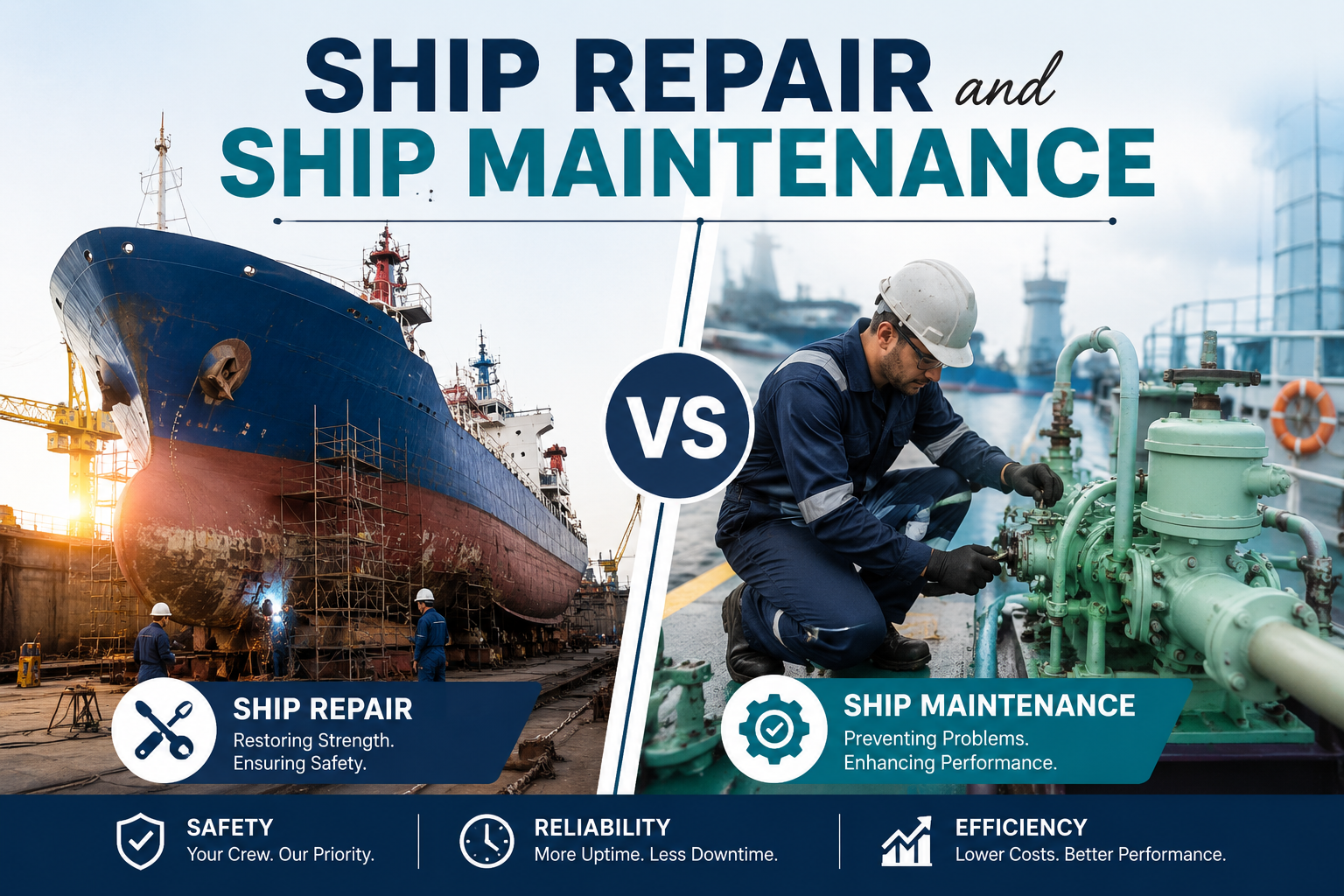
Ship Repair vs. Ship Maintenance: What’s the Difference?
In the maritime industry, the terms ship repair and ship maintenance are often used interchangeably. While both are essential for keeping vessels seaworthy, they serve different purposes. Understanding the distinction helps shipowners, fleet managers, and technical teams plan maintenance budgets, reduce downtime, and ensure compliance with international maritime regulations.
This guide explains the key differences between ship repair and ship maintenance, why both are important, and how they work together to improve vessel performance and safety.
Key Takeaways
-
Ship maintenance is a planned and preventive process designed to avoid equipment failures.
-
Ship repair is a corrective process carried out after damage, malfunction, or breakdown has occurred.
-
Routine maintenance reduces the need for expensive emergency repairs and extends a vessel's service life.
-
Ship repairs can range from minor equipment replacements to major structural work requiring dry docking.
-
Combining preventive maintenance with timely repairs improves operational efficiency, safety, and regulatory compliance.
-
Working with an experienced marine service provider ensures smooth maintenance and repair support across every stage of vessel operations.
What Is Ship Maintenance?
Ship maintenance refers to the routine servicing, inspection, and preventive care performed to keep a vessel in safe and efficient operating condition. Its primary objective is to identify potential issues before they develop into costly failures.
Instead of waiting for equipment to break down, maintenance focuses on preserving the health of the vessel's machinery, systems, and structure through scheduled inspections and servicing.
Typical Ship Maintenance Activities
-
Routine inspection of engines and propulsion systems
-
Lubrication of machinery and moving components
-
Hull cleaning and anti-corrosion treatment
-
Inspection and testing of navigation and safety equipment
-
Scheduled replacement of filters, seals, bearings, and other consumable parts
-
Planned servicing based on the vessel's Planned Maintenance System (PMS)
Most maintenance activities follow manufacturer recommendations, classification society requirements, and international maritime regulations. Modern fleet operators rely on computerized maintenance management systems (CMMS) to monitor maintenance schedules and ensure no critical service intervals are missed.
What Is Ship Repair?
Ship repair services is the process of correcting faults, damage, or equipment failures that have already occurred. Unlike maintenance, repairs are generally reactive and are performed only when something needs to be restored or replaced.
Repairs may become necessary because of mechanical failure, corrosion, accidents, grounding, heavy weather, or normal operational wear and tear.
Common Ship Repair Activities
-
Hull and structural repairs
-
Engine overhauls after mechanical failure
-
Replacement of damaged propellers, rudders, or shafts
-
Electrical and automation system repairs
-
Emergency repairs following collisions or grounding
-
Repairs identified during vessel inspections or surveys
Depending on the severity of the damage, repairs may be completed while the vessel is afloat, alongside a berth, or during dry docking at a shipyard.
Ship Repair vs. Ship Maintenance: Key Differences
| Factor | Ship Maintenance | Ship Repair |
|---|---|---|
| Purpose | Prevent future problems | Correct existing damage or failure |
| Approach | Preventive | Corrective |
| Planning | Scheduled and planned | Often unplanned or urgent |
| Cost | Predictable and relatively lower | Can be significantly higher |
| Frequency | Regular and ongoing | As required |
| Location | Onboard or alongside berth | Shipyard or dry dock for major work |
| Downtime | Minimal when properly planned | May result in extended operational downtime |
Understanding these differences enables fleet operators to allocate maintenance budgets effectively while minimizing costly disruptions caused by unexpected breakdowns.
Why Ship Maintenance Matters
Preventive maintenance plays a vital role in maximizing vessel performance and ensuring uninterrupted operations. A well-maintained vessel is not only safer but also more economical to operate.
Benefits of Regular Ship Maintenance
-
Extends the operational life of the vessel
-
Reduces unexpected machinery failures
-
Improves fuel efficiency
-
Ensures compliance with classification societies and maritime regulations
-
Enhances crew safety
-
Minimizes operational downtime
-
Lowers long-term repair costs
Neglecting routine maintenance often results in larger failures that require expensive repairs, making preventive maintenance one of the smartest long-term investments for any shipping company.
Types of Ship Repairs
Ship repairs generally fall into several major categories depending on the affected system.
Structural Repairs
These involve repairing damage to the hull, decks, bulkheads, tanks, or superstructure caused by corrosion, fatigue, impact, or structural stress.
Machinery Repairs
Includes repairing or replacing engines, generators, pumps, compressors, propulsion equipment, and auxiliary machinery.
Electrical and Automation Repairs
Focuses on restoring navigation equipment, communication systems, switchboards, sensors, alarms, and automation controls.
Emergency Repairs
Performed immediately after incidents such as collisions, grounding, flooding, fire, or severe weather damage to restore vessel safety.
Dry Dock Repairs
Major maintenance and repair work conducted after the vessel is removed from the water, allowing access to underwater hull sections, propellers, rudders, sea valves, and other submerged components.
Preventive Maintenance vs. Corrective Repair
Modern shipping companies primarily follow two maintenance strategies.
Preventive Maintenance
Preventive maintenance involves scheduled inspections and servicing intended to prevent failures before they occur. This proactive approach minimizes equipment breakdowns and extends machinery life.
Corrective Repair
Corrective repair addresses equipment failures after they have already occurred. Although unavoidable in certain situations, relying heavily on corrective repairs generally results in higher maintenance costs and increased vessel downtime.
The most successful fleet management strategies prioritize preventive maintenance while responding quickly whenever corrective repairs become necessary.
How Frequently Should Ships Be Maintained?
Maintenance schedules vary depending on vessel type, operating conditions, age, manufacturer recommendations, and classification society requirements.
A typical maintenance schedule includes:
-
Daily operational inspections
-
Weekly machinery checks
-
Monthly equipment servicing
-
Quarterly system inspections
-
Annual surveys and servicing
-
Dry docking every 2.5 to 5 years for major structural inspections and underwater maintenance
Following a structured maintenance schedule significantly reduces the risk of emergency repairs and unexpected operational interruptions.
Choosing the Right Marine Service Partner
Whether your vessel requires scheduled maintenance or emergency repair support, selecting a reliable marine partner is essential for maintaining operational efficiency.
Aasutosh Marine, a trusted ship chandler in Kandla and ports across India, provides comprehensive marine supplies, technical assistance, ship repair coordination, and maintenance support to help vessels remain operational during every port call.
Partnering with experienced marine professionals ensures timely service, regulatory compliance, and reduced vessel downtime while keeping maintenance and repair costs under control.
For more practical maritime insights, explore our related articles on vessel maintenance best practices and marine engineering solutions.
Frequently Asked Questions
What is the difference between ship repair and ship maintenance?
Ship maintenance is a planned preventive activity that keeps a vessel operating efficiently, while ship repair focuses on fixing existing faults, damage, or equipment failures after they occur.
Why is ship maintenance important?
Routine maintenance improves vessel safety, reduces equipment failures, increases fuel efficiency, extends operational life, and helps vessels comply with international maritime standards.
What are the different types of ship repairs?
Ship repairs generally include structural repairs, machinery repairs, electrical system repairs, emergency repairs, and dry dock repairs.
How often should a ship undergo maintenance?
Most vessels follow daily, weekly, monthly, annual, and periodic dry dock maintenance schedules based on their operating profile and classification requirements.
Is preventive maintenance more cost-effective than repairs?
Yes. Preventive maintenance identifies potential problems early, reducing expensive breakdowns, minimizing downtime, and lowering overall operating costs.
What happens during dry docking?
During dry docking, the vessel is removed from the water so technicians can inspect the hull, perform underwater repairs, remove marine growth, treat corrosion, and complete major structural or machinery work.
How does regular maintenance reduce repair costs?
Routine inspections and scheduled servicing detect minor issues before they become major failures, helping shipowners avoid costly repairs, emergency downtime, and operational disruptions.

 English
 Arabic
 French
 Spanish
 Portuguese
 Deutsch
 Turkish
 Dutch
Dutch
 Italiano
 Russian
 Portuguese (Brazil)
 Greek
Greek
