


 About Urh Social
 Terms of Service
 Privacy Policy
 Contact
EPE vs POE vs EVA Encapsulant: What's the Difference?
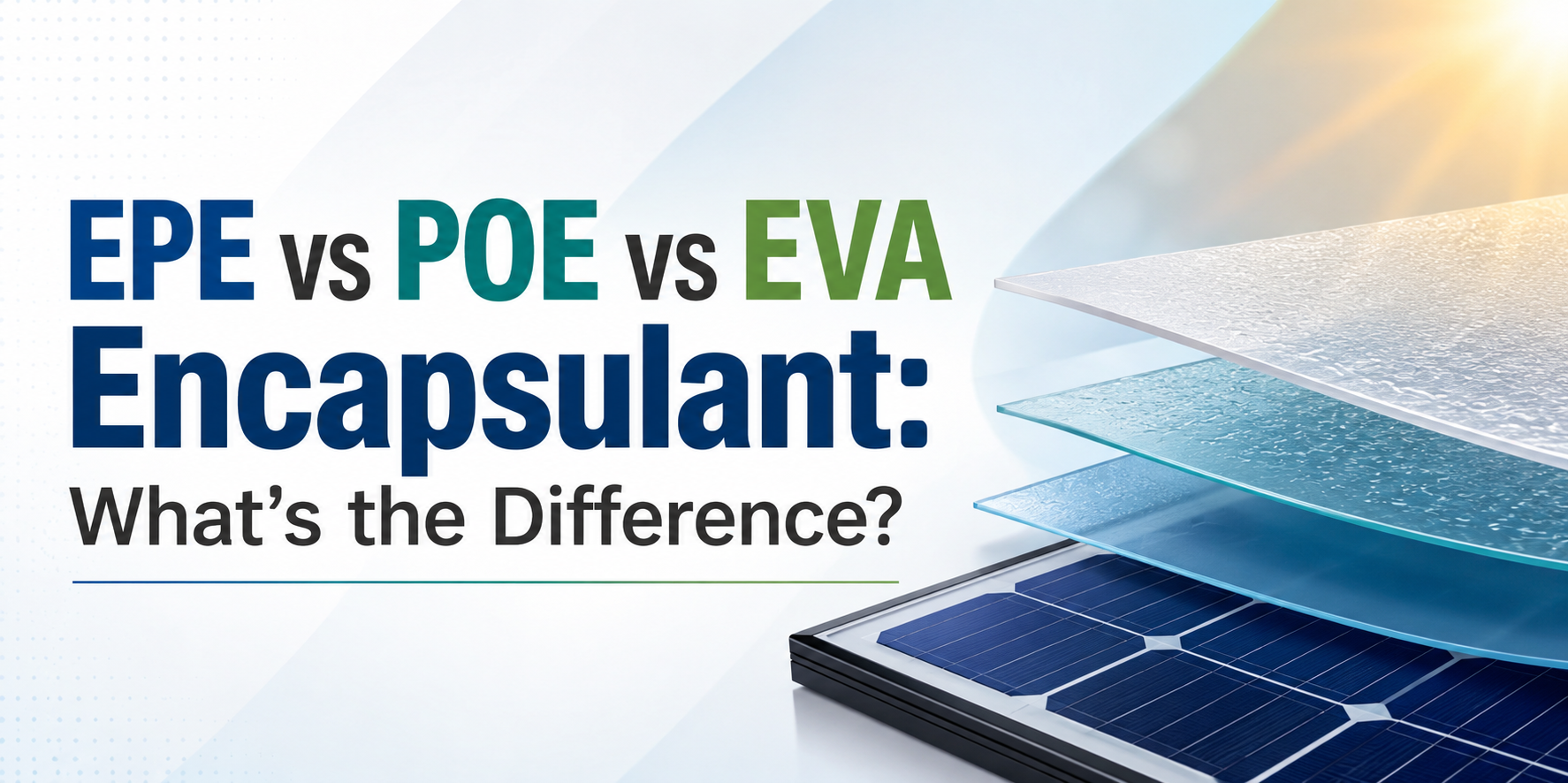
Imagine buying a brand-new car and leaving it out in the rain without any paint or protection. It wouldn't last very long, right? Solar panels are the same way. They sit under the hot sun and pouring rain for 25 years or more. To keep the fragile solar cells safe, manufacturers use a special protective layer. This layer is called an encapsulant. It acts like a clear, strong glue that holds everything together and keeps the elements out.
But not all protective layers are the same. Today, the industry talks a lot about EPE vs POE vs EVA. If you are looking into how solar panels are made, you need to know which one of these materials works best for different situations. Each has its own strengths, and picking the right one can make a huge difference in how long a solar panel lasts and how much power it makes over time.
What Is a Solar Encapsulant?
A solar encapsulant is a thin sheet of material placed on both sides of the solar cells. During the manufacturing process, these sheets are melted down to seal the cells between the top glass and the back sheet. Think of it like a laminated ID card, but much more advanced. These solar encapsulant materials provide physical support, stop water from getting in, and help the panel handle high heat and cold.
Without this layer, the silver wires and silicon cells would rust or break very quickly. The choice of material depends on the type of panel and where it will be installed. For many years, one material ruled the market, but as technology gets better, new options like POE and EPE have become very popular for high-performance panels.
What Is EVA Encapsulant?
EVA stands for Ethylene Vinyl Acetate. It has been the go-to choice for the solar industry for decades. It is a polymer that becomes soft and clear when heated. Most of the solar panels you see on rooftops today use Solar EVA Encapsulant because it is a reliable and well-understood material. It was the first real solution for keeping solar cells safe from the outside world.
Key Features of EVA
- High light transmission: One of the best things about EVA is how clear it is. It lets almost all the sunlight pass through to the solar cells, which is exactly what you want for making electricity.
- Strong adhesion: It sticks incredibly well to the glass and the back sheet. This creates a solid block that is hard to pull apart, protecting the cells from vibrating or moving.
- Cost-effective: Because it has been around for so long, it is very cheap to produce. This helps keep the overall price of solar panels down for homeowners.
- Easy lamination: It melts at a predictable temperature, making the PV module lamination process fast and simple for factories.
Advantages of EVA Encapsulant
The biggest plus for EVA Encapsulant is its history. We know how it behaves after 20 years in the sun. It is very affordable and works perfectly for standard solar panels that don't face extreme moisture or high-voltage stress. For most residential solar projects, it provides the best balance between price and performance.
Limitations of EVA Encapsulant
Despite its popularity, EVA has some downsides. Over a long time, it can turn slightly yellow or brown due to UV light, which blocks some sunlight. It also isn't the best at stopping water vapor. If moisture gets inside, it can cause the material to break down and produce acetic acid (vinegar), which can eat away at the metal parts of the solar cell.
What Is POE Encapsulant?
POE stands for Polyolefin Elastomer. This material was created to solve the problems that EVA couldn't handle. It is much better at keeping water out and staying stable under tough conditions. Many high-end panels, especially bifacial panels that catch light from both sides, use POE Encapsulant to ensure they stay efficient for a long time.
Key Features of POE
- Excellent moisture resistance: POE is like a raincoat for solar cells. It blocks water vapor much better than EVA does, which prevents corrosion.
- Superior PID resistance: PID stands for Potential Induced Degradation. It's a technical way of saying the panel loses power because of electrical leaks. POE stops this from happening.
- High electrical insulation: It is a great insulator, which is why it is preferred for the newest, high-efficiency N-type solar cells.
- Long service life: It doesn't turn yellow or break down into acid, so the panels stay clear and healthy for longer.
Advantages of POE Encapsulant
The main benefit of POE Encapsulant is its toughness. If you are installing panels near the ocean or in very humid places, POE is the superior choice. It keeps the panel working at its peak for its entire lifespan without the risk of internal chemical damage. It is the gold standard for high-performance modules.
Limitations of POE Encapsulant
The main reason everyone doesn't use POE is the cost. It is more expensive than EVA. It is also a bit harder to work with during manufacturing because it can be slippery and takes longer to process in the machines. This can slow down production and raise the price of the final product.
What Is EPE Encapsulant?
EPE is a "sandwich" material. It stands for EVA-POE-EVA. It was designed to give manufacturers the best of both worlds. By putting a layer of POE in the middle and layers of EVA on the outside, you get a sheet that is easier to use than pure POE but much stronger than pure EVA. EPE Encapsulant is becoming the favorite for modern bifacial solar modules.
Key Features of EPE
- Combines EVA and POE benefits: You get the great sticking power of EVA and the water-blocking power of POE.
- Improved moisture protection: The POE core acts as a barrier, keeping the solar cells dry even if the outer layers are exposed to humidity.
- Better durability: It resists PID and yellowing much better than standard EVA alone.
- Cost-effective alternative to pure POE: Since it uses less POE material, it is cheaper than a full POE sheet but offers nearly the same level of protection.
Advantages of EPE Encapsulant
Using EPE Encapsulant is a smart move for many companies. It fits easily into existing factory setups without needing expensive new machines. It provides the high-level protection needed for modern, high-efficiency cells while keeping the costs manageable. It is basically the "middle ground" that offers high quality without the high price tag of pure POE.
Limitations of EPE Encapsulant
While EPE is great, it is still a multi-layer material. This means the layers must be perfectly bonded together. If the quality of the EPE sheet isn't high, there is a small risk that the layers could separate over time. It requires a high level of precision during the manufacturing stage to ensure it lasts for 30 years.
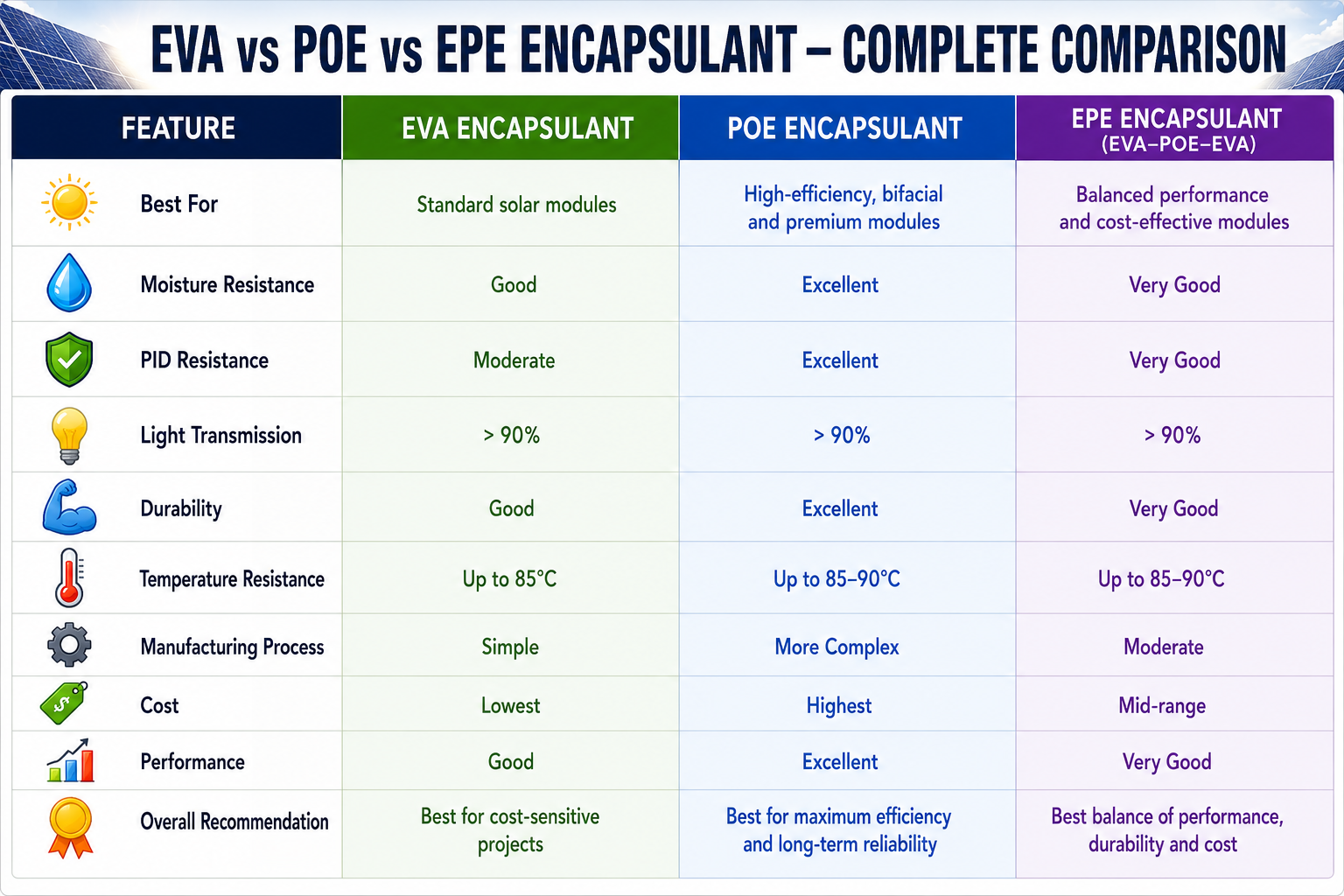
EPE vs POE vs EVA Encapsulant – Quick Comparison
Why Choose Raynex Solar for High-Quality Solar Encapsulants?
At Raynex Solar, we understand that every solar project is different. We don't just provide one-size-fits-all solutions. We offer top-tier materials that help solar panels survive the toughest climates on Earth. Whether you need the reliability of EVA or the advanced protection of POE and EPE, we have the expertise to guide you. Our focus is on long-term value, making sure your solar investment stays safe and productive for decades.
Conclusion
Choosing between EPE vs POE vs EVA doesn't have to be confusing. It all comes down to what you need for your specific panels. EVA is reliable and cheap. POE is the ultimate protector against moisture and electrical loss. EPE is the smart, modern bridge between the two. By understanding these differences, you can make a better choice for your solar installation, ensuring your panels stay clear, strong, and powerful for many years to come.
Frequently Asked Questions
Which is better for bifacial solar panels, EVA or POE?
POE or EPE are usually better for bifacial panels. They prevent PID (Potential Induced Degradation) and handle moisture much better than standard EVA, which is important for the high-efficiency cells used in bifacial modules.
Why does EVA turn yellow over time?
EVA can turn yellow because of long-term exposure to UV rays and heat. This chemical reaction happens more often in older or lower-quality EVA materials, which can eventually block sunlight and reduce the panel's power output.
Is EPE cheaper than POE?
Yes, EPE is generally more cost-effective than pure POE. Because it uses a sandwich structure of EVA and POE, it requires less of the more expensive POE resin while still providing excellent moisture resistance.
Does the encapsulant affect the life of a solar panel?
Absolutely. The encapsulant is what seals the cells. If the encapsulant fails, moisture enters, the metal parts rust, and the panel will stop working. Choosing a high-quality material like POE or EPE can extend the panel's life.
Can I use EVA for all types of solar panels?
While you can use EVA for many panels, it is not recommended for the newest N-type or bifacial panels. These newer technologies are more sensitive to moisture and PID, making POE or EPE a much safer choice.

 English
 Arabic
 French
 Spanish
 Portuguese
 Deutsch
 Dutch
Dutch
 Italiano
 Russian
 Romaian
 Portuguese (Brazil)
 Greek
Greek
