Embroidery digitizing is a technical process that converts artwork into stitch files for embroidery machines. However, the quality of the final embroidery does not depend only on digitizing—it also depends heavily on the quality of the source artwork.
Clean, well-prepared vector artwork plays a critical role in ensuring smooth embroidery production. When artwork is messy, pixelated, or poorly structured, even advanced digitizing services struggle to create accurate stitch files.
Vector artwork is a scalable design created using paths, curves, and mathematical points instead of pixels.
It is commonly used in embroidery because it provides:
Clean outlines
Scalable shapes
Editable design structure
High production accuracy
Common vector file formats include:
AI
EPS
SVG
PDF
CDR
These formats help digitizers convert designs into accurate embroidery files.
Why Clean Artwork Is Important Before Digitizing
Embroidery machines do not read images directly—they follow stitch files created from vector artwork.
If the artwork is unclear or poorly structured, the digitizing process becomes more difficult and less accurate.
Poor-quality artwork can lead to:
Distorted embroidery shapes
Inaccurate lettering
Uneven stitch paths
Excessive manual correction
Production delays
Clean vector artwork helps avoid these issues and improves overall embroidery output.
1. Improves Stitch Accuracy
Clean vector files provide clear paths and shapes for digitizers to follow.
This results in:
Accurate stitch placement
Better logo proportions
Smooth embroidery edges
When artwork is unclear, digitizers may have to manually fix shapes, which can reduce precision.
2. Reduces Digitizing Time
High-quality vector artwork simplifies the digitizing process.
Reliable artwork allows digitizers to:
Work faster
Reduce manual corrections
Focus on stitch optimization instead of fixing design errors
This leads to quicker turnaround times for embroidery projects.
3. Prevents Embroidery Errors
Poor artwork often leads to production problems such as:
Thread breaks
Misaligned stitching
Fabric distortion
Inconsistent logo appearance
Clean vector files reduce these risks by providing structured and accurate design data.
4. Improves Small Lettering Quality
Small text is one of the most difficult parts of embroidery.
Clean vector artwork ensures:
Proper spacing
Clear letter shapes
Better stitch readability
Without clean artwork, small lettering may become unreadable after stitching.
5. Enhances Brand Consistency
Brand identity depends on accurate logo reproduction across all products.
Clean vector artwork helps maintain:
Consistent logo shapes
Accurate proportions
Uniform embroidery results
This is especially important for uniforms, merchandise, and corporate branding.
6. Reduces Cost of Corrections
When artwork is clean, fewer revisions are needed during digitizing.
This helps businesses:
Avoid extra revision charges
Reduce production delays
Minimize wasted materials
Good artwork preparation saves both time and money.
What Makes Vector Artwork “Clean” for Embroidery?
Clean vector artwork should have:
Smooth curves and paths
No broken or overlapping shapes
Proper alignment
Organized layers
Editable text elements
Such files are easier to convert into embroidery stitch files.
Role of Vector Art Services in Embroidery Workflow
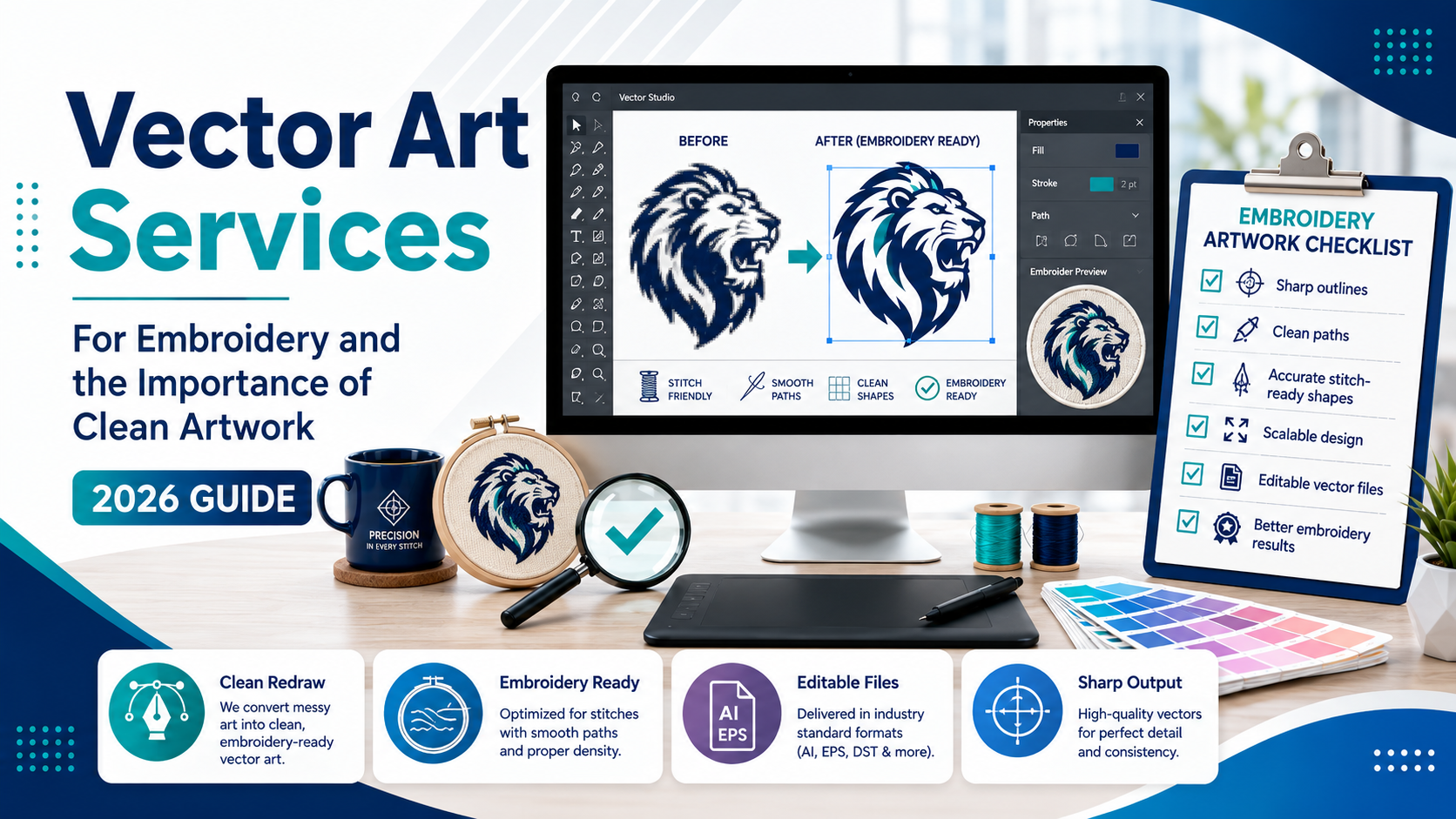
Professional vector art services prepare artwork specifically for embroidery digitizing.
They help by:
Converting raster images into vector format
Cleaning rough edges and shapes
Fixing design inconsistencies
Optimizing files for digitizing use
This ensures embroidery digitizers receive production-ready artwork.
Common Mistakes in Artwork Preparation
Many businesses face embroidery issues due to poor artwork preparation such as:
Using low-resolution images
Sending screenshots instead of vector files
Ignoring design cleanup
Using auto-traced files without correction
Overcomplicated design elements
Avoiding these mistakes improves embroidery quality significantly.
How Clean Artwork Helps Embroidery Businesses
For embroidery shops and apparel brands, clean vector artwork improves:
Production efficiency
Machine performance
Customer satisfaction
Brand presentation
Order consistency
It also helps businesses scale operations without quality issues.
Conclusion
Clean vector artwork is the foundation of successful embroidery digitizing. Even the most advanced digitizing techniques cannot fully compensate for poor-quality source files.
Reliable vector art services ensure that artwork is properly prepared, structured, and optimized before digitizing begins. This improves stitch accuracy, reduces production errors, and supports consistent branding.
In 2026, businesses that prioritize clean vector artwork before digitizing achieve better embroidery quality, faster production, and stronger brand identity.
FAQs
Why is clean vector artwork important for embroidery?
It ensures accurate stitch conversion, better logo quality, and fewer production errors.
Can poor artwork affect embroidery quality?
Yes, low-quality artwork can lead to distorted logos and stitching issues.
What file formats are best for embroidery digitizing?
AI, EPS, SVG, PDF, and CDR are commonly used vector formats.
Do vector art services help before digitizing?
Yes, they clean and prepare artwork for accurate embroidery conversion.
Does clean artwork reduce production cost?
Yes, it reduces revisions, errors, and material waste during embroidery production.



 About Urh Social
 Terms of Service
 Privacy Policy
 Contact

 Arabic
 French
 Spanish
 Portuguese
 Deutsch
 Turkish
 Dutch
Dutch
 Italiano
 Russian
 Romaian
 Portuguese (Brazil)
 Greek
Greek
